21. The Thing (1982)
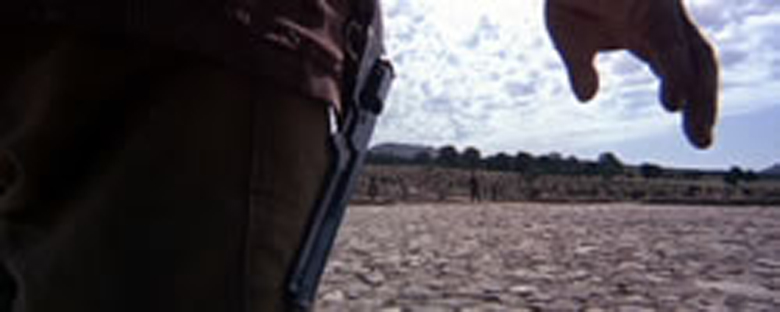
 My favourite John Carpenter film. The Thing takes place in an Arctic outpost after the discovery of the frozen remains of an extra terestrial life form. When the alien starts to come back to life and seems to be able to take the form of its victims, the tension and paranoia between the remaining characters begins to mount. Like many of Carpenters films, The Thing is a suspenseful waiting game. In a career of atmospheric movies, it is the most atmospheric. Kurt Russell is memorable as the outposts whiskey drinking hellicopter pilot, MacReady. The special effects are astonishing, and probably represent the zenith of animatronics in cinema.
20. Battle Royale (2000)

Veteran director Kinji Fukasaku's final masterpiece. The story of Battle Royale is adapted from the bestselling novel of the same name by Koushun Takami. Basically, a class of school kids are put on a deserted island and given three days to kill each other using randomly allocated weapons ranging from an uzi to a dustbin lid. The shocking and excessive violence emphasizes the characters emotional turmoil in what is perhaps one of the most unusual of teen dramas. The movie features a subtly chilling performance from 'Beat' Takeshi Kitano, the famous film maker and comedian, as the homocidal ex-teacher "Mr Kitano". A uniquely entertaining and violent joyride.
19. Santa Sangre (1989)
 Alejandro Jodorowsky's macabre masterpiece was produced by, and co written with Claudio Argento (brother to the Italian horror master, Dario), who seems to have added atleast a touch of the giallo to the story about a young man who kills in the name of his semi-deified, armless mother. It is infact, a giallo in a Hispanic style, with the baroque tone of the Italian sub-genre replaced by a decidedly surrealist one. The characters in the film are frequently archetypes, almost allegories, representatives of some universal element. The film also seems to borrow stylistically from the work of Herschell Gordon Lewis and José Mojica Marins, but the symbolism and storytelling is altogether more complete. It seems Jodorowsky has taken their work as far as it will go, or atleast to another level. The plot is far too complexed to recount at this point, but suffice it to say that Santa Sangre is a highly symbolic, bloody, sex massacre of the highest calibre.
18. Goldfinger (1964)
 Guy Hamiltons first of many forays into the Bond universe is the most famous and perhaps most consistent of all. In this adventure, Bond is assigned to spy on bullion dealer Auric Goldfinger, and somehow ingratiate himself into the billionaire's company in order to ascertain how he's smuggling gold internationally. In doing so, Bond also uncovers a plan to contaminate the Fort Knox gold reserve with radioactive material, and thereby bankrupt North America while simultaneously sending the price of gold sky-rocketing. What makes this particular Bond movie stand out is, apart from Hamiltons superior directing, a particularly well crafted script by Paul Dehn and Richard Maibaum. The dialogue is excellent, but more importantly the story is well paced and each scene feels as important as the last, which I think is unusual for a Bond film. It seems to be a film heavily grounded in Hollywood classicism, and as such remains a crucial influence on directors like Spielberg and Lucas. Sean Connery is the original and, for me, remains the best incarnation of the Ian Fleming character.
17. Alien (1979)
 Ridley Scott's astonishing sci-fi horror classic manages to incorporate the most intriguing elements of both genres. In the future, the crew of the commercial towing spaceship Nostromo are awakened from their hypersleep (a technologically induced coma) by Mother, the spaceships computer, which has detected a mysterious signal emanating from a nearby planet. It appears they are contractually obliged, by the nameless corporate entity they work for, to investigate the phenomena. The crew reluctantly alter course and eventually land on the seemingly un-inhabitable planetoid. They learn that the signal is coming from another craft, a derelict of alien and seemingly ancient origin. The dark, stormy environment of the planet, and the presence of a 'ghost ship', as a device representing the protagonists possible fate, are both classic staples of horror storytelling and aesthetics. Add to this a genuinely terrifying alien antagonist, who's appearance, famously designed by H. R. Giger, seems to suggest both in its head shape and protruding second mouth, an erect phalice, and what we have is something very far away from a traditional sci-fi movie. The aliens phallic appearance gives it emphasis as an aggressive intruder, a sort of rape nightmare made flesh. In the films open ending, the only surviving crew member, warrant officer Ripley (Sigourney Weaver), along with the ships cat, is left drifting on a lifeboat, returning to hypersleep in the hope that someone, somewhere, will find them.

16. Black Sabbath (1963)
 One of Mario Bava's greatest horror films is a classic example of the horror tryptich, a film made up of multiple segmented stories. Black Sabbath, like most tryptich's, is divided into three stories, with an introduction to each one featuring horror legend Boris Karloff. The first story, The Telephone, is set in the modern day. A woman returns home from a night out to find her phone ringing. She answers it but hears only a heavy breathing. She puts the receiver down and gets ready for bed, but then the phone rings again. And again. And again. The Telephone is perfect in its simplicity. A story about modern day paranoia. The second story is called The Wurdulak and also stars Boris Karloff as the patriarch of a family harbouring a dark secret in rural, 19th century Russia. The third and final part, entitled The Drop of Water, sees a nurse in Victorian London racked with guilt after stealing a ring from the hand of a deceased, elderly lady, who turns out to have been a famous medium. As always, with ex-cinematographer Bava, the film is beautifully shot, with deep black shadows punctuating the lurid primary colours. Red with green, purple and yellow.
15. Enter The Dragon (1973)
Bruce Lee's most iconic moment and undoubtedly the best film of a career so unfortunately cut short, Enter The Dragon is a Bond style, 70's, martial arts extravaganza. Lee plays a martial artist proficient in Kung Fu, who is invited to take part in a martial arts tournament which is held every three years on an island close to Hong Kong that is owned by the reclusive and mysterious Han, who is suspected by British authorities of being behind a large scale prostitution and heroin trafficking empire. Lee is recruited by British intelligence to enter the tournament in order to basically assassinate Han, who has banned guns from his island. Also competing are two Americans. Roper, a bankrupt playboy (played by John Saxon) hoping to pay his mob debts, and Williams (played by real life Karate champion Jim Kelly), a black political activist on the run after defending himself against two racist, white policemen. The three of them become loose allies in an environment thick with corruption and oppression. Lee's final showdown with Han in a mirrored labyrinth has to be one of the most iconic scenes in 70s action cinema.
14. The Man Who Would Be King (1975)
13. Army of Darkness (1992)
The culmination of Sam Raimi's Evil Dead Trilogy, Army of Darkness is an extraordinary example of horror-comedy script writing, and a cult classic. Bruce Campbell reprises his role of zombie killer Ash Williams, who as a result of being pulled into a time portal at the end of Evil Dead 2, finds himself in Britain in the year 1300. The source of all his problems in the previous films was the Necronomicon, a book bound in human skin and written in blood that has the power to awaken malevolent spirits that apparently inhabit the world around us. These spirits have already possessed his fiance, forcing him to kill her, horribly, and infected his hand, forcing him to cut it off and replace it with a chainsaw. After falling through the time portal, he is taken prisoner by some knights and taken back to their castle to be sacrificed by being thrown into a pit that houses one of the possessed. It seems that the Necronomicon also holds sway over this time and place. After defeating the evil 'Deadite' with his 'Boom Stick', Ash is celebrated as a hero. Eventually he learns that to return home he must retrieve the Necronomicon, BUT he can only remove it safely from its resting place after reciting the words "Klaatu verata nicto". Unfortunately, Ash fails to remember the words and, after taking the book anyway, ends up reviving an army of Deadites who descend on the castle. The script, written by Raimi and his brother Ivan, is pretty much a stream of classic, endlessly quotable one liners. For me, one of the defining movies of the 90s.
12. The Birds (1963)
 For me truly one of Alfred Hitchcock's most enjoyable and complexed movies. Adapted from a short story by Daphne du Maurier, The Birds basic premise is of a small coastal town being suddenly attacked by flocks of birds of varying species, who seem to be acting in unison. The story concerns wealthy socialite Melanie Daniels (Tippi Hedren) who after meeting journalist Mitch Brenner (Rod Taylor) in a San Francisco pet shop, decides to continue the strange flirtation and follow him back to the coastal town where he lives. Eventually a relationship seems to blossom and Melanie meets his mother, young sister and ex-girlfriend, who is the local school teacher. The birds of the title, and their unexplained behavior, seem to be caused by, or at least symbolic of, a kind of underlying tension between Melanie and the other women. Her sudden appearance in the town, and subsequently Mitch's life, seem to correspond with the birds first attacks, and she seems to be singled out by them on at least one occasion. Another possible cause, symbolic or otherwise, seems to be the sexual tension between Mitch and Melanie, which is exacerbated in the beginning by their almost excessive flirting and teasing of each other. However you analyse the story, the visual motif of a flock of birds silently congregating, with malicious intent, around a small town is truly chilling, an image that seems to haunt popular culture.
11. The Godfather part 1 (1972)
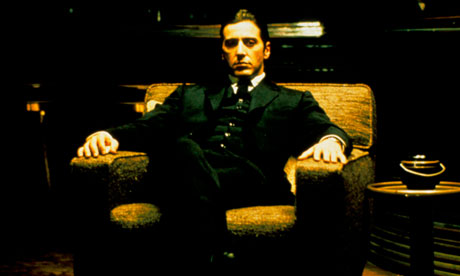 Francis Ford Coppola's sprawling epic about the ascension of the young heir of an Italian-American mafia dynasty, is a true classic of Hollywood cinema. Al Pacino plays Michael, the youngest son of mob Don, Vitto Corleone (played by Marlon Brando) who presides over a racketeering empire on the east coast of America in 1945. In contrast to his older brothers Sonny (James Caan) and Fredo (John Cazale), Michael initially has no desire to join the family business, instead he goes to college and serves in World War 2, eventually returning as a war hero. In spite of all this, or most likely because of it, he is his fathers favourite. He becomes engaged to a young teacher, Kay (Dianne Keaton), but eventually his plans for a normal life are put into jeopardy when his father is gunned down one day and falls into a coma. Michael can't help but become involved when he finds himself largely alone in the hospital where his father is, after the police expel all the men who where meant to be guarding him. It soon becomes apparent that a corrupt police chief was responsible for this, and is siding with their enemies. After saving his fathers life by moving him to a different room and fending off potential assassins, Michael agrees to act as bait to draw the police chief and the man responsible for his fathers attempted murder out again by agreeing to a sham meeting, where he will infact assassinate both of them. After, he is sent to Sicily to hide out and visits his fathers home town. Returning from Italy, he appears to have changed, he seems to be re-tracing his fathers footsteps, and eventually becomes the Don himself after the death of his older brother Sonny. Aside from the rich content of the story and characters, the beautiful, film-noir inspired cinematography by Gordon Willis and Nino Rota's iconic score make the film also an aesthetic masterpiece. Essentially, The Godfather part 1 is about a man who, by chance and misshap, becomes his father. A fairly universal theme for one of the most famous genre movies ever made.