My list of favourite films continues in no particular order.
80. The Apple (1998)
Directed by Samira Makhmalbaf when she was just 17, The Apple is based on the true story of twins Massoumeh and Zahra Naderi, who were imprisoned at home by their father until the age of 11. The films cast was made of non-actors and infact the girls and their family appear as themselves. The seemingly eccentric father of the two girls could have been depicted as an opressive monster, but instead he is imbued with genuine pathos. The dialogue was improvised according to a script co-written by Makhmalbaf with her father Mohsen (an acclaimed director in his own right). The episodic story, and the distinctive cinematography of Ebrahim Ghafori, give the film a symmetry and beauty. A true story told through visual poetry, the film also seems to be a fable with the apple of the title as the fruit of knowledge.
79. Come and See (1985)
Elem Klimov's iconic movie about the Nazi invasion of Belarus during the second world war, Come and See is as harrowing as it is beautiful. The war is abstracted, reduced (or perhaps elevated) to a seemingly endless prossesion of images which are unforgetable. Its a profoundly visual film. The title of the movie seems apt, although its also a reference to The Book of Revelations ("I heard the voice of the fourth beast say, Come and see. And I looked, and behold a pale horse: and his name that sat on him was Death, and Hell followed with him. And power was given unto them over the fourth part of the earth, to kill with sword, and with hunger, and with death, and with the beasts of the earth").
The story is told, or rather shown, from the perspective of a boy, Florya, who is apparently just old enough to join the Russian resistance forces against the Germans. At first he is eager to join, but soon becomes disillusioned and eventually completely broken by the violence and atrocities he witnesses and barely survives. The intensity escalates until its final harrowing climax which is essentially a vision of hell. In the end Florya is a different person, a hardened soldier, but he is also a civilian. His face seems to represent all the victims of war, particularly of THAT war.
78. Love Exposure (2008)
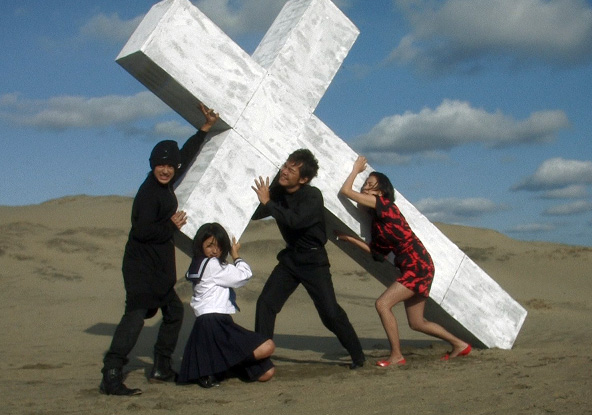
Cult director Shion Sono's four hour epic on the human condition and the nature of love has to be one of the greatest films of modern times, and certainly of the 21st century. This is a love story with a unique religious context, that of the Catholic Japanese. Its a film so long, and so full of ideas, that its hard to remember everything that happens and in what order, its a bit like trying to recount the last ten years of your life to a stranger. The plot is fairly bizarre. Yu is the son of a priest who falls in love with his step sister, Yoko, whom he sees as the Virgin Mary.
Yoko, however, seems to regard Yu with disdain. She is infact a lesbian, and in love with her adopted mother, Yu's step mother, Keiko. During the course of the film, and for various reasons, Yu finds fame as an 'upskirt' porn photographer and also creates a female alter ego whom Yoko falls in love with, not knowing that its him. With the arrival of the mysterious Aya, the head of a sinister cult known as Zero Church, and who has become strangely infatuated with Yu, things start to take a darker turn as it becomes a love triangle of rejected youth. Love Exposure left me emotionally drained. At times incredibly sad, but also very funny.
77. Weekend (1967)
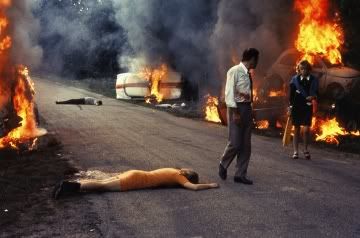
Jean-Luc Godard's Weekend is essentially the story of a journey through the French countryside, but unlike other road movies the protagonists are not rebels or outcasts, but merely a modern, outwardly respectable, bourgeois Parisian couple. Roland and Corinne are a husband and wife who are both having affairs and plotting the others murder. They decide to visit Corrine's wealthy father in the country in order to murder him and stop him from changing his will. So begins their 'Weekend'. From the very outset of the film motorists are shown in conflict with one another. The characters of these early scenes also seem outwardly respectable: affluent, even glamourous, white Parisians, but their behavior is distinctly base. Animalistic. They behave excessively with each other, either through violence or verbal abuse, to the point of absurdity. These occurrences seem to intensify in the country, which is apparently abundant with car accidents and bloody fatalities, to a point verging on apocalyptic. After the couple crash and write off their own car, they attempt to flag down a car. The driver confronts Roland with a question, "Are you real, or in a film?" to which Roland replies "in a film". The man in the car drives away exclaiming "you lie to much!". Eventually they are captured by some hippie cannibals and Roland is eaten. Corrine joins them and seems nonplussed by the death of her husband. Godard paints a picture of the French class struggle, and in particular depicts the French middle class as terminally shallow and materialistic. The irony is that these are the very people who would probably end up watching the film. Godard is perhaps laughing at himself as much as anyone else.
76. Shogun's Samurai (1978)
A masterful example of samurai melodrama by veteran director Kinji Fukasaku, Shogun's Samurai takes place after the death of the second Tokugawa shogun in 1623, and concerns the subsequent struggle for power between his two sons, the stammering, birth-marked heir Iemitsu, and his younger brother, the popular and benevolent Tadanaga, his fathers favourite. Various factions choose their side and what results is a hugely entertaining, if largely fictional account of a war of intrigue and political machinations during an established historical period. What it lacks in historic accuracy it makes up for in atmosphere and high drama, the plot is practically Shakespearean. So many characters and sub plots emerge, the story eventually takes on a truly epic scale, until a final, violent and satisfyingly dramatic climax. Whether it happened is unimportant, its a great story, and brilliantly acted by the cast which includes Toshiro Mifune and Sonny Chiba.
75. The Spirit of the Beehive (1973)
This uniquely touching film by Spanish director Victor Erice, has to be one of the greatest ever made about a childhood. Ana is a small girl living in a Spanish town just after the civil war (sometime around 1939). She spends much of her time with her sister Isabel, who is slightly older and has told her about a mysterious 'spirit' who lives nearby. Ana's imagination attributes this spirit to Boris Karloff's Frankenstein, from the James Whale film which has been shown in the town's improvised cinema, and later to a Republican soldier she encounters, who is on the run from Nationalist forces, now the established power in the country. Post civil war Spain is shown abstractly through the eyes of these two sisters, who are offcourse quite innocent and oblivious to the political climate of the time. The issues are therefore tackled with a degree of subtlety, which allowed the film to be made in the early 70's, the waning days of this same oppressive regime that had existed since the war.
74. Mother and Son (1997)
The first in acclaimed director Alexander Sokurov's cycle of films dedicated to platonic, familial love, Mother and Son is in intensely original and unique work of cinematic art. The film features only the characters of the title, a mother and son. The mother appears to be gravely ill, and the son is her carer. There is no geographical or chronological context, it is unclear where they are or when it is, the only suggestion of a world outside them is the occasional sight of a steam train, and later a sailing ship, both seen from a great distance. Their relationship seems therefore magnified. Sokurov stretched the film so that the images are distorted, and sometimes the lens even seems dirty or smudged with water, creating blurs in the frame. It looks and feels like nothing else. Surely one of the most beautiful films ever made.
73. Mirror (1975)
Andrei Tarkovsky's most personal film, Mirror is a partially autobiographical account of Russian life from the 30s, until the 70s when the film was made. The three periods of pre-wartime, wartime and post-wartime Russia are represented un-chronologically, in a series of flashbacks, archive footage and present day scenes and seemingly abstract, dreamlike sequences which are visually startling even by Tarkovsky's standards. All jumping back and forth in the life of Alexei, the films protagonist, as if in a process of thought. The present day scenes are infact shot subjectively, looking out from inside the protagonists head, his adult face is never seen, but his voice, the voice of the narrator, is heard throughout the film. Margarita Terekhova, who plays Alexei's mother during the childhood scenes, also plays his ex-wife in the contemporary ones, and the young actor who plays Alexei as a child in the 30s also plays his son in the 70s. Alexei's mother in the 70s is played by Tarkovsky's own mother. Despite all of this, the film is never indulgent. On the contrary, its astonishing originality and style are strangely moving. Its a film which manages to be at once intensely personal and subjective, and yet also somehow universal.
72. Pather Panchali (1955)
The startling debut feature of Satyajit Ray, who would go on to become the most prominent Bengali film maker working outside the bollywood system, Pather Panchali's beauty is in its story and incredible pathos. It was adapted from a novel by Bengali author Bibhutibhushan Bandyopadhyay, and is the first part in what would become known as 'The Apu Trilogy' after Ray also adapted the novel's sequel into two more films: Aparajito (1956) and The World of Apu (1959). The story of Pather Panchali concerns an impoverished writer's family living in their dilapidated ancestral home in rural Bengal, and in particular his young son, Apu. As his father is often away trying to find work, Apu grows up around three women. His elderly aunt, his mother and his older sister, Durga. He is particularly close to his sister, they seem to experience everything together, they're a team. The movie is probably one of the earliest examples of a film telling its story exclusively from a child's perspective (along with Yasujiro Ozu's 1932 film I Was Born, But...), and undoubtedly one of the most touching and beautiful. Although its set in the 1920s, the only hint that we are in the recent past is in Durga and Apu's astonishment at the telephone lines and steam train they encounter in one of the films most iconic scenes. A profoundly moving and ultimately tragic story told with exceptional style by Ray, Pather Panchali is in my opinion one of the greatest films of and about the 20th century.
71. The Deer Hunter (1978)
The Deer Hunter is simply one of the greatest American films ever made, and truly one of the greatest films ever about blue-collar American life, its dreams and hardships. Examining the impact of war on a small group of friends from a working class, Russian-American community, it is also certainly the most subtly moving film to be made about the war in Vietnam. The cast is essentially a who's who of 70s method actors. Mike (Robert De Niro), Stan (John Cazale, in his last role), Nick (Christopher Walken), Steven (John Savage) and Axel (Chuck Aspegren) are childhood friends who all work in a steel refinery in Clairton, a small town in western Pennsylvania. The movie opens on the evening of Steve's wedding. These are the last few hours of their adolescence. High school photographs of Mike, Nick and Steve are hung up at the wedding reception along with a banner reading "Serving God and Country Proudly". They have all signed up for Vietnam and are dew to be shipped out soon. Gradually their individual characters are introduced. Mike is a sort of quintessential Russian male, stoic and overtly masculine. His best friend, Nick is a sensitive, slightly introverted individual. From the start he is the most detached of the group. Steven is a hen-pecked mothers boy. Stan an extroverted and slightly erratic ladies man, and Axel is the hard drinking, life and soul of the party. The characters are so beautifully drawn by writer director Michael Cimino, and perfectly interpreted by the cast, and this is ultimately what makes the film so engaging. After Steven's wedding, the rest of the guys, along with another friend, a piano playing barman called John (George Dzundza), decide to go hunting for deer. Mike reveals his ethos of 'one shot' in regards to deer hunting. "One shot is what its about. Two shots is pussy." The wedding and hunting sequences at the beginning of the film are the last time all the characters are together, the last time they are happy. After the war everything will be different. The films second act takes place in Vietnam. Mike, Nick and Steve are captured by the Viet Cong and forced to play Russian roulette. The resulting scene is perhaps one of the most succinct portrayals of the life and death situation in war. During the third act, when Mike eventually returns, alone, to the community they all grew up in, he and Nick's sweetheart, Linda (Meryl Streep) take solace in each other and seem to bond over their love for Nick. All in all, a subtle and beautifully structured masterpiece.
21. The Thing (1982)
My favourite John Carpenter film. The Thing takes place in an Arctic outpost after the discovery of the frozen remains of an extra terestrial life form. When the alien starts to come back to life and seems to be able to take the form of its victims, the tension and paranoia between the remaining characters begins to mount. Like many of Carpenters films, The Thing is a suspenseful waiting game. In a career of atmospheric movies, it is the most atmospheric. Kurt Russell is memorable as the outposts whiskey drinking hellicopter pilot, MacReady. The special effects are astonishing, and probably represent the zenith of animatronics in cinema.
20. Battle Royale (2000)
Veteran director Kinji Fukasaku's final masterpiece. The story of Battle Royale is adapted from the bestselling novel of the same name by Koushun Takami. Basically, a class of school kids are put on a deserted island and given three days to kill each other using randomly allocated weapons ranging from an uzi to a dustbin lid. The shocking and excessive violence emphasizes the characters emotional turmoil in what is perhaps one of the most unusual of teen dramas. The movie features a subtly chilling performance from 'Beat' Takeshi Kitano, the famous film maker and comedian, as the homocidal ex-teacher "Mr Kitano". A uniquely entertaining and violent joyride.
19. Santa Sangre (1989)
Alejandro Jodorowsky's macabre masterpiece was produced by, and co written with Claudio Argento (brother to the Italian horror master, Dario), who seems to have added atleast a touch of the giallo to the story about a young man who kills in the name of his semi-deified, armless mother. It is infact, a giallo in a Hispanic style, with the baroque tone of the Italian sub-genre replaced by a decidedly surrealist one. The characters in the film are frequently archetypes, almost allegories, representatives of some universal element. The film also seems to borrow stylistically from the work of Herschell Gordon Lewis and José Mojica Marins, but the symbolism and storytelling is altogether more complete. It seems Jodorowsky has taken their work as far as it will go, or atleast to another level. The plot is far too complexed to recount at this point, but suffice it to say that Santa Sangre is a highly symbolic, bloody, sex massacre of the highest calibre.
18. Goldfinger (1964)
Guy Hamiltons first of many forays into the Bond universe is the most famous and perhaps most consistent of all. In this adventure, Bond is assigned to spy on bullion dealer Auric Goldfinger, and somehow ingratiate himself into the billionaire's company in order to ascertain how he's smuggling gold internationally. In doing so, Bond also uncovers a plan to contaminate the Fort Knox gold reserve with radioactive material, and thereby bankrupt North America while simultaneously sending the price of gold sky-rocketing. What makes this particular Bond movie stand out is, apart from Hamiltons superior directing, a particularly well crafted script by Paul Dehn and Richard Maibaum. The dialogue is excellent, but more importantly the story is well paced and each scene feels as important as the last, which I think is unusual for a Bond film. It seems to be a film heavily grounded in Hollywood classicism, and as such remains a crucial influence on directors like Spielberg and Lucas. Sean Connery is the original and, for me, remains the best incarnation of the Ian Fleming character.
17. Alien (1979)
Ridley Scott's astonishing sci-fi horror classic manages to incorporate the most intriguing elements of both genres. In the future, the crew of the commercial towing spaceship Nostromo are awakened from their hypersleep (a technologically induced coma) by Mother, the spaceships computer, which has detected a mysterious signal emanating from a nearby planet. It appears they are contractually obliged, by the nameless corporate entity they work for, to investigate the phenomena. The crew reluctantly alter course and eventually land on the seemingly un-inhabitable planetoid. They learn that the signal is coming from another craft, a derelict of alien and seemingly ancient origin. The dark, stormy environment of the planet, and the presence of a 'ghost ship', as a device representing the protagonists possible fate, are both classic staples of horror storytelling and aesthetics. Add to this a genuinely terrifying alien antagonist, who's appearance, famously designed by H. R. Giger, seems to suggest both in its head shape and protruding second mouth, an erect phalice, and what we have is something very far away from a traditional sci-fi movie. The aliens phallic appearance gives it emphasis as an aggressive intruder, a sort of rape nightmare made flesh. In the films open ending, the only surviving crew member, warrant officer Ripley (Sigourney Weaver), along with the ships cat, is left drifting on a lifeboat, returning to hypersleep in the hope that someone, somewhere, will find them.
16. Black Sabbath (1963) One of Mario Bava's greatest horror films is a classic example of the horror tryptich, a film made up of multiple segmented stories. Black Sabbath, like most tryptich's, is divided into three stories, with an introduction to each one featuring horror legend Boris Karloff. The first story, The Telephone, is set in the modern day. A woman returns home from a night out to find her phone ringing. She answers it but hears only a heavy breathing. She puts the receiver down and gets ready for bed, but then the phone rings again. And again. And again. The Telephone is perfect in its simplicity. A story about modern day paranoia. The second story is called The Wurdulak and also stars Boris Karloff as the patriarch of a family harbouring a dark secret in rural, 19th century Russia. The third and final part, entitled The Drop of Water, sees a nurse in Victorian London racked with guilt after stealing a ring from the hand of a deceased, elderly lady, who turns out to have been a famous medium. As always, with ex-cinematographer Bava, the film is beautifully shot, with deep black shadows punctuating the lurid primary colours. Red with green, purple and yellow.
15. Enter The Dragon (1973)
Bruce Lee's most iconic moment and undoubtedly the best film of a career so unfortunately cut short, Enter The Dragon is a Bond style, 70's, martial arts extravaganza. Lee plays a martial artist proficient in Kung Fu, who is invited to take part in a martial arts tournament which is held every three years on an island close to Hong Kong that is owned by the reclusive and mysterious Han, who is suspected by British authorities of being behind a large scale prostitution and heroin trafficking empire. Lee is recruited by British intelligence to enter the tournament in order to basically assassinate Han, who has banned guns from his island. Also competing are two Americans. Roper, a bankrupt playboy (played by John Saxon) hoping to pay his mob debts, and Williams (played by real life Karate champion Jim Kelly), a black political activist on the run after defending himself against two racist, white policemen. The three of them become loose allies in an environment thick with corruption and oppression. Lee's final showdown with Han in a mirrored labyrinth has to be one of the most iconic scenes in 70s action cinema.
14. The Man Who Would Be King (1975)
John Huston's adaptation of a story by Rudyard Kipling, The Man Who Would Be King is, to me, one of the greatest adventure movies and features two stand out performances from Michael Caine and Sean Connery. In turn of the century British India, Rudyard Kipling (played by Christopher Plummer) is confronted by an elderly beggar while working late at the headquarters of the Northern Star newspaper. The beggar reveals that he is infact 'Peachy' Carnehan, the well dressed man Kipling met just three years earlier on the first class carriage of a train. Originally, Carnehan (Caine) had introduced himself in order to return a gold watch he had infact stolen from Kipling at the train station moments earlier. Carnehan, an ex-non-commissioned officer in the Indian Army and general adventurer and rogue, reveals himself as a fellow Freemason, and that he was forced to return the watch after finding the emblem of Freemasonry carved into the back. He takes the opportunity to ask Kipling to deliver a message to his friend, Daniel Dravot (Connery), another roguish, de-mobbed officer, who should be travelling that way in a few days time. Kipling delivers the message, and eventually forgets about these two eccentric, seemingly quintessentially British characters. One day soon after, the pair show up at Kipling's Northern Star office, explaing that they need him to witness a contract. They pledge to abstain from drink and women until such time as they find the semi mythical kingdom called Kafiristan, which lies beyond the Kyber Pass. Once there, they plan to use their knowledge of tactical warfare to take control of the region, that they have heard is filled with primitive warring tribes, and return as rich men. Classically directed, the movie was hailed by many as Huston's best film since The African Queen. It remains one of my favourites since childhood.
13. Army of Darkness (1992)
The culmination of Sam Raimi's Evil Dead Trilogy, Army of Darkness is an extraordinary example of horror-comedy script writing, and a cult classic. Bruce Campbell reprises his role of zombie killer Ash Williams, who as a result of being pulled into a time portal at the end of Evil Dead 2, finds himself in Britain in the year 1300. The source of all his problems in the previous films was the Necronomicon, a book bound in human skin and written in blood that has the power to awaken malevolent spirits that apparently inhabit the world around us. These spirits have already possessed his fiance, forcing him to kill her, horribly, and infected his hand, forcing him to cut it off and replace it with a chainsaw. After falling through the time portal, he is taken prisoner by some knights and taken back to their castle to be sacrificed by being thrown into a pit that houses one of the possessed. It seems that the Necronomicon also holds sway over this time and place. After defeating the evil 'Deadite' with his 'Boom Stick', Ash is celebrated as a hero. Eventually he learns that to return home he must retrieve the Necronomicon, BUT he can only remove it safely from its resting place after reciting the words "Klaatu verata nicto". Unfortunately, Ash fails to remember the words and, after taking the book anyway, ends up reviving an army of Deadites who descend on the castle. The script, written by Raimi and his brother Ivan, is pretty much a stream of classic, endlessly quotable one liners. For me, one of the defining movies of the 90s.
12. The Birds (1963)
For me truly one of Alfred Hitchcock's most enjoyable and complexed movies. Adapted from a short story by Daphne du Maurier, The Birds basic premise is of a small coastal town being suddenly attacked by flocks of birds of varying species, who seem to be acting in unison. The story concerns wealthy socialite Melanie Daniels (Tippi Hedren) who after meeting journalist Mitch Brenner (Rod Taylor) in a San Francisco pet shop, decides to continue the strange flirtation and follow him back to the coastal town where he lives. Eventually a relationship seems to blossom and Melanie meets his mother, young sister and ex-girlfriend, who is the local school teacher. The birds of the title, and their unexplained behavior, seem to be caused by, or at least symbolic of, a kind of underlying tension between Melanie and the other women. Her sudden appearance in the town, and subsequently Mitch's life, seem to correspond with the birds first attacks, and she seems to be singled out by them on at least one occasion. Another possible cause, symbolic or otherwise, seems to be the sexual tension between Mitch and Melanie, which is exacerbated in the beginning by their almost excessive flirting and teasing of each other. However you analyse the story, the visual motif of a flock of birds silently congregating, with malicious intent, around a small town is truly chilling, an image that seems to haunt popular culture.
11. The Godfather part 1 (1972)
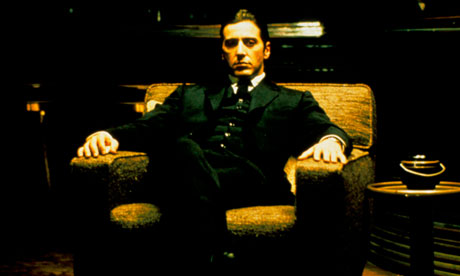
Francis Ford Coppola's sprawling epic about the ascension of the young heir of an Italian-American mafia dynasty, is a true classic of Hollywood cinema. Al Pacino plays Michael, the youngest son of mob Don, Vitto Corleone (played by Marlon Brando) who presides over a racketeering empire on the east coast of America in 1945. In contrast to his older brothers Sonny (James Caan) and Fredo (John Cazale), Michael initially has no desire to join the family business, instead he goes to college and serves in World War 2, eventually returning as a war hero. In spite of all this, or most likely because of it, he is his fathers favourite. He becomes engaged to a young teacher, Kay (Dianne Keaton), but eventually his plans for a normal life are put into jeopardy when his father is gunned down one day and falls into a coma. Michael can't help but become involved when he finds himself largely alone in the hospital where his father is, after the police expel all the men who where meant to be guarding him. It soon becomes apparent that a corrupt police chief was responsible for this, and is siding with their enemies. After saving his fathers life by moving him to a different room and fending off potential assassins, Michael agrees to act as bait to draw the police chief and the man responsible for his fathers attempted murder out again by agreeing to a sham meeting, where he will infact assassinate both of them. After, he is sent to Sicily to hide out and visits his fathers home town. Returning from Italy, he appears to have changed, he seems to be re-tracing his fathers footsteps, and eventually becomes the Don himself after the death of his older brother Sonny. Aside from the rich content of the story and characters, the beautiful, film-noir inspired cinematography by Gordon Willis and Nino Rota's iconic score make the film also an aesthetic masterpiece. Essentially, The Godfather part 1 is about a man who, by chance and misshap, becomes his father. A fairly universal theme for one of the most famous genre movies ever made.
Recently been watching a lot of these old Italo-westerns, the latest one is Requiem for a Gringo a.k.a. Duel in the Eclipse. It's about a guy who uses various atmospheric elements to defeat a group of outlaws, in the end he uses an eclipse, hence the alternative title. I've also ordered a film called Mannaja: A Man Called Blade, the opening sequence on Youtube looks really incredible, like a western with elements of a horror film. It was directed by Sergio Martino, who is more famous for making these sinister Italian style 'Giallo' thrillers like Torso. The Giallo is another great Italian invention. It's basically like a murder mystery with an emphasis on violence and esthetics, for example the murderers often wear black gloves, shiny raincoats, use a mask or have their face hidden. These films are also characterised by the use of the subjective (point of view) shot, usually to represent the murderer who's identity isn't revealed until the very end. Although Bava really started them I guess Dario Argento perfected this style. In Italy in the early 70's, after Argento made The Bird With the Crystal Plumage, there was a surge of Giallo thrillers, nearly all of them with an animal in the title. Most Italian directors made at least one. The Italian film industry used to be huge in th 60's and 70's, some studio directors like Fulci or Bava where releasing two of three films a year, thats amazing compared to your average hollywood director making about one film every two years, if that. If you watch a film like Keoma by Castellari the cinematography is so far beyond anything being made in America at the time.
Keoma is pretty epic, it's like an opera. Franco Nero is also amazing in this film, just physically. He even sang on the song in this clip.
Aside from Italo-westerns, this film is also really great:
http://www.youtube.com/watch?v=V9QekeOkSi8
Its one of the films Charles Bronson made with Michael Winner a few years before they hit the big time with Death Wish. It's much better than Death Wish though. Michael Winner is obviously best known in this country for those amazing Esure adverts where he always tells people to calm down.
Wanna get this film called Samurai Reincarnation, think its basically a samurai film with zombies and sorcery.
It's by the director of Battle Royale, Kinji Fukasaku. He's one of the most prolific and respected Japanese directors but, similar to someone like Lucio Fulci, I think he's made a lot of 'trash' as well.
Finally saw The Serpent and the Rainbow. Easily Wes Cravens best film.
Richard Stanley made a film with the same actor, called Dust Devil. It was only his second film but after he made it he stopped making features, apparently he had a lot of problems getting it distributed properly or getting his cut released or something. His first film Hardware is also a classic.
Also finally saw this film, Beastmaster.
It's writen and directed by Don Coscarelli, who I think is the only true genius auter working in American cinema now. He also wrote and directed the Phantasm movies and a film called Bubba Ho-tep. All are a must see.
Watched The Outsiders recently, it's Coppola's companion piece to Rumble Fish based on another book by S. E. Hinton. It deals with similar subjects as Rumble Fish and it's basically a really good sort of chick flick with aesthetic references to Gone With The Wind. R.I.P. Patrick Swayze. Stay gold.