Showing posts with label Richard Stanley. Show all posts

Sunday, 14 August 2011

Even More of The Greatest part 1

As before they're not in any particular order.


60. Ride in the Whirlwind (1965)

Some time during the mid sixties Roger Corman gave director Monte Hellman the money to make two western b-movies, to be shot more or less at the same time. The first was The Shooting, a kind of existential take on the traditional western stereotypes whith Jack Nicholson as a black clad, sociopathic gunfighter and Warren Oates as kind of architypal western hero in the style of Ethan Edwards. Infact, Oates characters paternal relationship with a younger protagonist is like a straight up homage to John Wayne in The Searchers. The Shooting has much of the best things of the traditional hollywood western, while at the same time waving farewell to it. The second film to be made was Ride in the Whirlwind. Made with much of the same cast as The Shooting (minus Oates) and from a script knocked together by Jack Nicholson, it nevertheless marks a drastic departure from its predecessor.
The architypes are replaced with beleivable characters. The incredible dialogue which carries most of the film is a sometimes bareley comprehensible stream of authentic 1870s north american slang and inflections. Watching this film you feel as if you're listening in on the old west, perhaps from an early record. Harry Dean Stanton plays a one eyed bandit called Blind Dick, who's gang robs a stagecoach in the opening scene of the film. They are tracked down and killed by a vigillante mob, who then mistake some nearby cowboys, Wes (Jack Nicholson) and Vern (Cameron Mitchell), for outlaws. Wes and Vern are forced to go on the run and even take a family hostage in order to escape their pursuers, essentially becoming what they where accused of being in the first place. Seemingly then, the film is a comment on subjective justice as a kind of physical embodiment of the 'lawlessenes' of the old west. Jack Nicholson, already one of the great actors, can apparently write too. Ride in the Whirlwind and The Shooting could also be seen as direct predecessors to a later more famous western, The Missouri Breaks, which also stared Jack Nicholson and Harry Dean Stanton (alongside Marlon Brando) and had a similar sense of authenticity and approach to dialogue.


59. The Name of the Rose (1986)

Jean-Jacques Annaud adapted this from a book by Umberto Eco, it's basically a murder mystery set in a remote abbey in northern Italy during the middle ages. It's thickly atmospheric, feeling for the most part like a horror film, Annaud seems to have deliberately chosen the ugliest actors to play the various characters, who in turn have been exagerated to the level of gargoyles. Sean Connery and Christian Slater play franciscan monks who have been sent to the abbey as representatives during a theological conference. As certain monks start turning up dead they soon uncover a conspiracy that reveals corruption in the catholic church itself, represented by an inquisitor played by a demonic looking F. Murray Abraham. It's good, late night fun.


58. The Double Life of Veronique (1991)


57. Satyricon (1969)

Federico Fellini's adaptation of the Roman text by Petronius, the story of Satyricon basically follows the exploits of two Roman men who start out as rivals in a love triangle with a young boy and then end up in a series of misadventures that take them on a kind of tour through Roman society. The original text is basically an attempt by a Roman writer to update, or satirise, the kind of Greek heroic myths in which young men are sent on these long journeys of discovery. In Satyricon however the two protagonists are distinctly un-heroic, and their journey is a chaotic series of mishaps brought about by their initial capture into slavery. In alot of ways this is a typical Fellini movie, lots of scary women with painted faces and the narrative progresses in this kind of dreamlike way, but it seems to take his cartoonish stylisation to a new level. It's a beautiful dream.
I think it's also notable among his films as being an adaptation of a well known work of literature rather than his own story. Usually I think of Fellini as a very autobiographical director who wrote most of his more well known films with a kind of confesional quality. This is apparent in what are arguably his three most famous films: 8 1/2, La Dolce Vita and Amacord (which translates as I Remember). The only other story that I'm aware of him adapting would be his 1976 film of Casanova's memoirs. Satyricon has something of the same atmosphere as Casanova, as I've said before it's very visually exagerrated, as if the further back he goes historically, the less 'realistic' he's prepared to be. Perversely, this can also add to the veiwers historical curiosity, a curiosity Fellini reveals himself in a film he made not long after Satyricon, Fellini's Roma.


56. Tokyo Story (1953)

Yasujiro Ozu's Tokyo Story is perhaps one of the greatest human dramas ever made. It's about the generational divide and the certainty of change and eventually death, set against the backdrop of what was apparently a transitional period for Japan in the early fifties. Ozu is well known for his family drama's and his distinctive visual style, the kind of odd low camera angles and tendency for filming actors straight on so that they are almost talking into the camera. The audience experiences the story as if a participant, first hand. Ozu himself is a slightly mysterious character. He seems to have rareley, if ever, given interviews. Ozu comes from the generation of directors who basically taught themselves how to make films from just watching movies, and apparently he spent much of his formative education in the cinema instead of the classroom. He was eventually expelled from the boys school he attended for sending love letters to a fellow student, so its possible he was a homosexual, a huge taboo in the Japan of the twenties. In Early Summer, a film he made a few years before Tokyo Story, the subject of arranged marriages is dealt with with vaguely homoerotic undertones. Like Tokyo Story and another film called Late Spring, Early Summer follows the character of Noriko (played as always by Ozu's muse, Setsuko Hara), a twenty something who is presurised to marry by her family. During the course of the story she is forced to decide whether she even wants to marry anyone. She remains reluctant untill almost the end of the film, and when she does finally choose a man it seems to be mostly because of his friendship and apparent loyalty to her dead brother (the war is never far away). No romantic melodrama here. The scene in which she asks his mother for her consent seems bizarre, as if she's asking his mother to marry her instead of him. The theme of repressed homosexuality is subtle but it's there. Tokyo Story was the last in this 'Noriko Trilogy', and I think the most succesful in achieving a sense of genuine pathos with the character's. In this film Noriko is a war widow who's relationship with her dead husbands parents is much deeper than that of their real children. The drama is understated as ever, but seemingly all the more poignant. The plot of Tokyo Story is episodic, like real life. One of the most distinctive things about Ozu's films is his sense of this kind of simple beauty in the cinematography, particularly in his famous establishing shots, and also his sense of rythm in the editing, it's just really well made, pure filmaking.


55. Hardware (1990)

Richard Stanley's horror sci-fi debut, Hardware is a cult oddity, crafted from elements of eighties's classics like The Terminator, Alien, Blade Runner and Mad Max. As an amalgamation of these films, it seems to represent a kind of quintessential eighties sci-fi action movie, with an added influence of the european horror films of Bava and Argento. In the comentary of the Optimum dvd release Stanley even admits to the film being "..a rip off of Terminator and Alien", it seems as if this was Richard Stanley trying to appease movie producers as much as the immagined audience. It was never more than a cult hit, this may be dew to the emphasis on dialogue and character development and lack of action in the first half. Hardware has some of the slow burning elements of a John Carpenter movie like The Thing or Assault on Precinct 13. Like Rio Bravo for the MTV generation. When it reaches its climactic second half the violence is concentrated and brutal, the film kind of explodes. Some of the eye gouging and various other things were cut out on it's initial release, and there are some other sequences that have stayed with me since I saw it when I was 11. The plot is looseley adapted from a story in the comic weekly 2000 A.D., about a homicidal skull faced robot called The Mark 13 that goes on the rampage through a post apocalyptic urban slum of the future. The use of eighties rock songs like P.I.L.'s The Order of Death and Iggy Pop's Cold Metal seem fitting and are well placed. More music by bands like Gwar and Ministry add to the film's gothic industrial aesthetic. Also of interest are the cameos: Fields of the Nephilim singer Carl McCoy plays an enigmatic "zone tripper", Lemmy from Motorhead appears as a taxi driver and Iggy Pop's voice is heard as a radio personality called Angry Bob. Bob's rants at the beginning and end of the film serve a narrative purpose, establishing first of all the context of the story, and finally the outcome in a kind of verbal epilogue, giving the feeling of a medieval play. It's certainly as violent and existential as any work of Shakespeare.


54. Immoral Tales (1974)

Walerian Borowczyk's Immoral Tales is one of the most famous erotic films of the seventies, but it has a dreamy quality and sense of the surreal that sets it apart from films like The Story of O and Emmanuelle. Immoral Tales is made of four segments, which regress cronologically, starting on a French beach in the present day and ending in fifteenth century Rome. The film is obviously about sex as sin. All the characters missbehave by the standards of their time, and seem to get worse as we go on, as if we are regressing also in a moral sense. Borowczyk's film seems to imply that morality itself is relative. The earlier scenes are atmospheric, closer to todays reality and more subdued. The later stories are presented rather more dramatically. The Countess Bathory segment is perhaps the most interesting and memorable, filled with surreal images. Paloma Picasso's performance as Elizabeth Bathory is detached and somewhat menacing. The Borgia family in the final segment are presented as the ultimate symbol of corruption, their incestuous relationships are a subversion of the family, in the Catholic Church in which the family is an important symbol of the relationship between man and God. It seems as if the more repressed the time and place the characters are from, the more corrupt they infact become, and sex and sensuality are represented as all the more enjoyable for being 'wrong'. The characters are not judged or punished by Borowczyk, they are shown objectively, as if specimens in a zoo.


53. Death in Venice (1971)
Luchino Visconti's masterpiece is an adaptation of the famous novel by Thomas Mann. The story concerns a 19th century Viennese composer Gustave Aschenbach, apparently based on Gustav Mahler, who travels to Venice after suffering from health problems brought about by a series of personal and artistic failures. Upon arrival he becomes secretly obssessed with a young Polish tourist called Tadzio. Eventually he tries to leave Venice, which appears to be in the grip of a cholera epidemic, only to return straight away after a minor problem concerning his luggage. It seems as if he is glad to return. He begins to openly follow the boy, to the extent that Tadzio's family notice him. Tadzio reminds him of his own past, seeming to embody everyone he has ever loved, including his dead daughter. It's incredibly poignant and sad. Visconti creates a sense of profound isolation around his central character, a solitary figure who hardly speaks to anyone. Aschenbach is a man at the end of his life, alone in a foreign country and trapped by his past. The dialogue is minimal, much of the film is carried by Dirk Bogarde's incredible performance as Aschenbach, and the music of Mahler resounds through the opening and closing scenes of the film, it seems like a wordless opera.


52. Tenebrae (1982)

Tenebrae is Dario Argento's last great giallo, it's also probably my favourite film of this much underrated genre. It's an incredibly violent film, almost all the characters are eventually killed, but as always the deaths are beautifully elaborate, his style is indesputable and very Italian. I particularly love the fact that in one scene a young girl is chased into the path of her killer by an over enthusiastic doberman, a cruel twist of fate typical of Argento's films. His characters often die in the most unlucky ways. Daria Nicolodi, the mother of Argento's daughter Asia, was often the brunt of these sadistic ironies: in Terror at the Opera she's not only shot in the head but through the eye. In Phenomena she's mauled by a razor weilding chimpanzee. In the climax of his early giallo, Cat o' Nine Tails, the murderer receives their comupence by falling down a lift shaft (after being shot) and on the way down burns their hands trying to hold on to the lift cable. He seems to like making his characters suffer, beyond what is required. Argento's violence is literally excessive.


51. 3 Women (1977)
By far Robert Altman's most disturbing and strangest film, 3 Women is a schizophrenic nightmare. Millie (Shelley Duvall) and Pinky (Sissy Spacek) share an appartment and work together at a health spa. They are both archetypes. Modern girl Millie is outgoing, sexually confident and shallow. Pinky is a country girl, shy and childlike. The appartment complex they live in is owned by an older woman, Willie (Janice Rule) a pregnant artist who paints horrific murals, depicting ferral, ape like creatures. The two younger women are also sporadically bothered by Willie's over sexed husband, Edgar. The three central characters are so exagerrated, Duvall and Spacek are clownlike.
Millie, Pinky and Willie all seem to exist apart from their surroundings and are treated with indifference and sometimes hostility. By the end of the film the three women have swapped roles to the extent that it suggests that they are merely facets of the same woman. In this sense it's similar to Bergman's Persona. This idea is more blatantly suggested in the ending which is horrific and mysterious.

Monday, 20 June 2011

Top 50

Some more of my favourite films. By this point they're in no particular order.


50. Badlands (1973).

This is Terrence Mallick's debut masterpeice which he made a few years before Days of Heaven. The way he uses voice narrative and music is kind of a revelation, theres no other filmaker like him. Badlands is the supposed true story of a couple of young misfits who went on a murder rampage in the 60's. Martin Sheen and Sissy Spacek are both great.


49. What? (1972)

Roman Polanski's What? is a kind of absurd comedy, similar in tone to his earlier film The Fearless Vampire Killers if you replace the gothic horror aesthetic with a kind of modern day Alice in Wonderland, and add lots of gratuitous nudity. I think it might be his take on the kind of European sex comedies of people like Tinto Brass, only funnier and much more elegantly directed. I'm a fan of Polanski's kind of subtle camera style, I could have just as easily included Frantic or The Ninth Gate in a list of my favourite films, and infact I probably will. Sydne Rome plays a young American tourist called Nancy who is almost raped while hitchhiking through Italy and finds herself seeking refuge in a coastal villa filled with strange characters. Marcello Mastroianni plays Alex (also sometimes referred to as Coco the Mashed Potato) a clap ridden pimp and Polanski appears as a perverted greek scuba diver called Mosquito: "..they call me that because I sting things mith my big stinger". Hugh Griffith plays Noblart, the elderly owner of the villa. After being "defiled" several times by Alex, Nancy falls in love with him only to find him indifferent. Like most of the characters, he seems to repeat the same frases and actions daily as if stuck in limbo. This theme is enhanced when it's suggested that they are infact waiting for the iminent death of Mr Noblart in the hope of inheriting some of his seemingly vast wealth. Sydne Rome is both hilarious and adorable as Nancy, who seems to gradually lose all her clothes during the course of the film and is forced to take this and the many other calamities in her stride. The themes of limbo and claustrophobia are offset by the light humour and the film is incredibly watchable and funny.


48. Kill Baby Kill (1966)


Arguably Mario Bava's greatest film, Kill Baby Kill is a masterpiece of gothic horror. Infact it's one of the best examples of this genre ever, long with other Bava films like The Mask of Satan (a.k.a. Black Sunday), Black Sabbath and The Whip and the Body. It's bursting with atmosphere and the cinematography is beautiful, Bava started as a cinematographer and his films have a trademark, beautiful kind of garish quality: deep black shadows complement primary colours. Shots in deep focus, the texture of objects and walls are vividly represented. Whithout Bava there would be no Dario Argento or Jess Franco and infact there would be no giallo film genre. He also invented the slasher film with Bay of Blood, influencing people like John Carpenter. Copolla's Dracula also has alot of blatant homages to Black Sabbath and The Mask of Satan, although Bava was a director who was under appreciated and remained fairly obscure during his lifetime. Most of his films were made with a tiny budget, he famously once used a wheelbarrow to achieve a tracking shot.


47. Dust Devil (1992).

Dust Devil is a kind of bizarre horror love story from Richard Stanley, the maverick director/writer responsible for Hardware. It revolves around three main characters: ageing police detective Ben Mukarob, housewife Wendy Robinson who is fleeing her abusive husband Mark and a mysterious hitchhiker who is also the enbodiment of a kind of desert spirit that kills people in order to take their souls. Wendy meets the drifter, who's murders are being investigated by Mukarob. Subsequently, Wendy's husband Mark teams up with Mukarob in order to find Wendy and they all come together in a kind of Tarkovskyesque climax. The film is narrated by Mukarob's friend Joe, the owner of a drive-in cinema. I think apart from just being a tripy horror film it's also a bit of an aesthetic homage to the Leone western. In the comentary Stanley admits to have been inspired to write Dust Devil after watching The Good, The Bad and The Ugly under the influence of hallucinogenic drugs.


46. The Serpent and The Rainbow (1988)
A largely unnoticed early gem from Elm Street and Scream director Wes Craven, The Serpent and The Rainbow is a really entertaining, fun horror film and also a kind of fascinating look into the world of Haitian voodoo and zombies. The late Zakes Mokae (Ben Mukarob from Dust Devil) gives an extaordinary performance as Mr Paytraud, the villanous witchdoctor and head of the secret police who terrorises Bill Pullman.


45. The Brides of Dracula (1960).

The Brides of Dracula is definateley my favourite Hammer movie, it's directed by the legendary Terence Fisher. He made most of the other good Hammer films including Frankenstein Must Be Destroyed, The Devil Rides Out, Curse of The Werewolf and the Dracula films. This is the only Dracula film made by Hammer without Christopher Lee in the title role (in fact the character of Dracula never appears), although Peter Cushing does turn up as Dr Van Helsing about half way through. I think its one of the few Hammer films to have a genuinely engaging plot and it doesn't rely on the same old Universal monsters. It's a true oddity. David Peel is excellent as Baron Meinster, a suave young vampire who becomes captivated by the new school mistress Marianne, played by the french actress and sex symbol Yvonne Monlaur. Monlaur also starred in another macabre gem of the same year: Circus of Horrors.


44. The Long Goodbye (1973).
Robert Altman's adaptation of the novel by Raymond Chandler. Elliott Gould is amazing as private detective Philip Marlowe, the role made famous by Humphrey Bogart in The Big Sleep. It's just a great detective story updated from the early 1950's of the book to Altman's 1970's hollywood. Altman is one of the greatest directors ever, having been responsible for some of the best American movies of the 70's, nameley: M*A*S*H, McCabe and Mrs Miller, Theives Like Us and 3 Women. In the early nineties he made The Player, a kind of satire of the hollywood film industry and followed it up with probably his greatest film: Short Cuts, inspired by the short stories of Raymond Carver.


43. Requiem for a Gringo (1968)
Requiem for a Gringo a.k.a. Duel in the Eclipse is a classic spaghetti western by Spanish director Jose Luis Merino. It was also rumoured to be co-directed by another Spanish director, Egenio Martin, the man behind the infamous spaghetti western The Ugly Ones. Regardless, Requiem is one of the most violent and unique spaghetti's from the heyday of this sub-genre, and remains one of the earliest and best examples of non linier storytelling in a comercial film. Ross Logan, a civil war veteran (played by Lang Jeffries), returns home to Mexico from travelling through central and south America. He soon clashes with a band of outlaws, the Carranza gang, after they kill his younger brother. One by one the distinctive characters in the Carranza gang disapear as Logan takes revenge, but not in the usual way. As he reveals in a final confrontation with the gangs leader (Fernando Sancho), he has used his extensive knowledge of astronomy and almost supernatural connection to the elements to trap and kill each one. By no means a typical western hero, Logan is a 'brujo', with his distinctive jaguar skin poncho as the apparent source of his power.


42. The Diabolical Doctor Z (1966)
Highly atmospheric and beautifully shot, this is my favourite film from one of my favourite cult directors, Jess Franco. He is the undisputed king of Euro-sleaze horror-exploitation films and alot of people mistake him for a hack. His films, particularly those from the 70s and onwards, often feature long meandering seaquences, or shots that are completely out of focus. These are both symptomatic of films where a director has only filmed one or two takes per shot (your average hollywood director might film between ten and fifty). The reason for Franco's thriftieness in filming was offcourse to save time and therefore money. It seems he rareley takes more than a week to make a film, from initial idea to final cut, the entire filming taking no more than two or three days. Apparently, during his busiest periods he also often made more than one film at the same time, and infact he claims to have tricked actors into being in more than one film whithout their knowledge. This was possible as Franco would often write each days scenes in his hotel room the night before, giving the actors little knowledge of the overall plot of the film, or films, they would eventually appear in. To date he's directed something like 150 movies. By his own admision a lot of these are trash but his best films, of which The Diabolical Doctor Z is one, are truly incredible.


41. Angel Heart (1987).
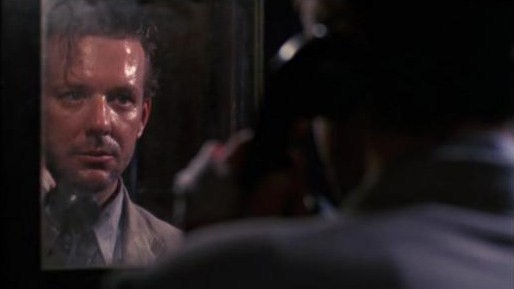
Angel Heart is a terrifying gothic noir thriller writen and directed by Alan Parker. It's about a private detective in 1950's New York called Harry Angel (played by Micky Rourke) who is hired by the demonic Louis Cyphre (Robert De Niro) to find Johny Favourite, a 30s jazz crooner who has been missing since the end of the war. The whole movie feels incredibly bleak and dark, a bit like a nightmare. As if the characters are already in hell. Lisa Bonnet of The Cosby Show plays Johny's morose/sexy daughter Epiphany who'm Harry meets when the hunt takes him to New Orleans.


40. Aguirre, The Wrath of God (1972)
One of Werner Herzog's early films, I think like the best of his work it's truly original. Herzog claims to have never seen a film until he was in his teens, as bizzarre as this sounds I think it's given him a unique perspective and approach to film making. Aguirre is a perfect example of this. Like many of his films its contemplative, water breaks on the rapids of a river for a full minute. It's the Amazon river and the film, almost a documentary, follows a group of sixteenth century conquistadors on an ill fated mission to find a city of gold. Apparently it's also partially a comment on the Vietnam war. The music by krautrockers Popol Vuh is beautiful, Klaus Kinski gives another memorable performance.


39. Bring Me The Head of Alfredo Garcia (1974).
One of my favourite examples of a Sam Peckinpah film. The opening scene featuring a man breaking the arm of his pregnant daughter sets the tone for the rest of the movie. It's a very dark tale about the power of money over a couple of outcast losers. Bad things happen. The amazing Warren Oates plays Bennie, a pianist in a Mexican bar who is approached by two sinister hitmen, Sappensly and Quill, to track down and kill an old aquantance of his, Alfredo Garcia. They offer him one million dollars in exchange for his head. Like in other Pekinpah classics like Straw Dogs, The Wild Bunch and Cross of Iron, the action/violence is beautifully stylised. Incedentally, in the opening scene of From Dusk Till Dawn, George Clooney's character threatens a shopkeeper by stating that he will "turn this place into the fucking Wild Bunch".


38. The House by The Cemetery (1981).

One of my favourite horror films of all time is Lucio Fulci's The House by The Cemetery. I can't begin to express how scary this film actually is. The funny thing is, it shouldn't be: it has an atrocious English language dub (like alot of Italian movies) and it centres around alot of aesthetic horror cliches (a cemetery and an old house with a haunted cellar). The fact that some sequences still make my hair stant on end is a testiment to the directing of Lucio Fulci. The film is incredibly atmospheric. A New York professor researching suicide takes his wife and their young son Bob to stay at an old mansion in a small town. Offcourse, one hundred years ago Dr Fraudstein lived there with his family, which he murdered in order to use their body parts in his experiments. They were buried in the house (apparently a common practice in the 19th century) and now it is haunted by a mysterious creature living in the basement.


37. The 36th Chamber of Shaolin (1978).

Yes! this is a wonderfully uplifting kung fu movie about triumph over adversity and the importance of perseverance and self discipline. Gordon Liu plays San Te, a young student in medieval China who comes to the Shaolin temple in order to learn their form of advanced kung fu so that he can create a resistance force against the invading northern Han empire. It features what is probably the all time greatest training sequences ever that takes up about half the movie. Liu is a legend.


36. Phenomena (1985).

My favourite Dario Argento film, and probably one of his most bizarre. A teenage Jennifer Connelly stars as a young American girl at a boarding school in Switzerland who finds she is capable of telepathy with insects. She teams up with a wheelchair bound Donald Pleasance to solve the murders that have begun to occur in the area. Highlights include a homicidal chimpanzee, general weirdness from Pleasance and a truly astonishing score that seems to mainly consist of Iron Maiden songs.


35. The Last Temptation of Christ (1988)

Not considered one of Scorsese's best films, nevertheless The Last Temptation of Christ is a favourite of mine and one that I seem to end up watching alot. It's an adaptation of the novel by the Greek writer and philosopher Nikos Kazantzakis. While I haven't read the book I think films often benefit from having the structure and concept of a novel behind them. Willem Dafoe's performance as Jesus is quite incredible and Peter Gabriels 80's score still sounds amazing. The minimalistic art direction is also remarkable, the film seems stripped down, spartan. A far cry from the traditional hollywood epic. This seems to suit the subject and recalls another great film based on the life of Jesus: Pasolini's The Gospel According to Saint Matthew.


34. Vertigo (1958)
Vertigo is the most emotionally satisfying of all Hitchcock's movies. I think it was his personal favourite, his magnum opus, and it's my favourite aswell, along with The Birds. James Stewart plays an ex-San Fransico police detective John "Scottie" Ferguson who is forced to retire after an incident on a roof top causes him to suffer from a fear of hights. One day he's approached by an old college friend to act as a private investigator and follow his wife in order to get to the bottom of her strange behaviour. The man believes that she has become obsessed with her dead ancestor Carlotta Valdes, and possibly even possessed by her spirit. It's a truly convincing portrayal of obssession and features one of the greatest unspoken sequences ever, along with one of the greatest musical scores by Bernard Herrmann.

Wednesday, 20 January 2010

More Lists


My most underrated directors:


10. Brian De Palma
De Palma is generally thought of as a sort of weakest link from the 70's generation of Neo-Hollywood directors that includes Scorsese, Coppola and Spielberg. I think this is a bit unfair, he's made some of the most interesting films of the late 70's and early 80's. Theres truly a different side to his earlier work, nameley the forgotten giallo style classics Sisters, Dressed to Kill and Blow Out, and Carrie has to be one of the greatest horror films of all time.


9. Paul Verhoeven
Going on his Hollywood career alone, Verhoeven deserves a place here. His sci-fi trilogy of Total Recall, Starship Troopers and his English language debut, Robocop, are some of the most subversive, and violent, Hollywood movies ever made. He further changed the game with Basic Instinct, a neo-noir sex thriller that would open the floodgates for a slew of inferior, but similar, movies.


8. Pier Paolo Pasolini
One of my favourite Italian directors. He may have a cult following, mostly among film students, but I think he deserves to be as well known as any of his contemporaries of Italian cinema of the 60s and 70s. His cinema ranges from his early, neo-realist inspired films about the Italian underclass (Accattone, Mamma Roma), to mystical films dealing with Greek mythology (Medea, Oedipus Rex), to later movies inspired by erotic literature (The Cantebury Tales, Arabian Nights, Salo), and what are simply classics of European cinema (Theorem, The Gospel According to Matthew).


7. Bernard Rose
Bernard Rose has made a couple of films that I really like. Most notably the horror film Candyman, a biography of Beethoven called Imortal Beloved and a fairly unknown and darkly comic crime thriller called Chicago Joe and the Showgirl which stars Kiefer Sutherland and the amazing Emily Lloyd. I think all three of these are worth buying. Candyman is a fucking masterpiece anyway.


6. Enzo G. Castellari
This guy has made so much stuff in Italy, what I've seen by him is amazing. He's supposed to be like the Italian Sam Pekinpah. I guess the best example I've seen is Keoma, but also Inglorious Bastards and the spaghetti western that this blog is named after. His films are really fun and he just has a great sense of style and a great eye.


5. Richard Stanley
I think Richard Stanley's only made about two feature films but they're both amazing. Hardware is a little known gem of a post apocalyptic horror slasher film. I'd say it's one of my all time favourite sci fi movies. His other feature is Dust Devil, which I can only describe as a kind of horror-western-lovestory-roadmovie-drugtrip-dreamsequence thing. He's also made a few odd little documentaries about things like the Nazi's quest for the Holy Grail and the practice of Voodoo in Haiti.


4. John McTiernan
McTiernan is on this list solely because of Predator and Die Hard, probably the two greatest action films of the 80's. If you're a boy then you must love these movies. They're basically just examples of really high quality film making. The guys a genius.


3. Michael Reeves
Reeves died of a barbiturates overdose in 1969 after directing only three films, all of which are horror classics. The last and most famous was Witchfinder General starring Vincent Price. I also love his first two films: The She Beast with Barbara Steele, and The Sorcerers with the incredible Boris Karlof, which I've mentioned on here before.


2. Don Coscarelli
Coscarelli is the contributor of such incredible examples of film making as the Phantasm series, Bubba Ho-tep and the truly amazing Beastmaster. He writes all these rich stories himself and then directs them with a sort of very dark sense of humour which I think only special people can really apreciate.


1. Lucio Fulci
What can I say about Lucio Fulci that I haven't already said on here at some point? the guy is probably one of the most underrated and missunderstood film makers ever. His best films were also written by him and I think in Italy he was known as a fairly prolific writer of screenplays and books. This guy had some issues to do with women, religion and the establishment in general and it comes out in his films, a lot of which are pretty excessively violent and crazy. He became known as "The Godfather of Gore", but his formidible imagination wasn't simply limited to depicting violence, he made some of the most inteligent thrillers and horror films of the 70's and early 80's.


Here are some more of my all time favourite films in no particular order:


33. Mamma Roma (1962)
Pier Paolo Pasolini's subtly beautiful and tragic masterpiece of his early period. Mamma Roma tells the sad tale of an ex prostitute, 'Mamma Roma', played by Anna Magnani. After her pimp, Carmine (played by Pasolini regular Franco Citti) gets married, she decides to rescue her estranged son Ettore (Ettore Garofolo) from the small town he lives in, and start a new life with him in the city, selling fruit and vegetables in a market. Soon Carmine returns demanding money and she is forced to go back to the streets at night. Meanwhile, Ettore meets local girl Bruna (Silvana Corsini) and falls in with a a group of street hoodlums. As the 16 year old Ettore starts to develop feelings for the thoroughly unsuitable Bruna, Mamma Roma's fears that he will become tainted and dragged down by their surroundings are realised in a tragic chain of events. Pasolini's early films, including Mamma Roma and his debut, Accattone, dealt with the forgotten underclass of pimps and prostitutes and small time criminals of post war Italy. They are stylistically rooted in Italian post modernism, and infact Pasolini never abandoned the rough aesthetic of this genre, using non actors and making the improvised, hand held camera style his own, long after many other directors had abandoned it.


32. Bad Lieutenant (1992)
Photobucket
Abel Ferrara's masterful character study, about an un-named, corrupt New York police detective (Harvey Keitel), follows him on a journey from total abandoned debauchery and corruption to a type or unexpected salvation, surrounding the case of a raped nun. It was co-written with actress Zoe Lund, who appears in the film as the lieutenants heroin dealer. Lund would later die in Paris of a cocaine related heart attack. This film is undoubtedly Ferrara's best and it remains one of the greatest and most thorough character studies in all of cinema.


31. The Texas Chainsaw Massacre (1974).
Photobucket
This film is just incredible. It looks great, it's possible to forget how artfully filmed it is, not just a typical slasher. It's definateley my favourite slasher film. Tobe Hoopers other films don't quite work as well, but somehow Chainsaw Massacre just comes together and it's perfect. It's like some sort of amazing fluke. An undisputed classic, the Citizen Kane of horror films.


30. Picnic at Hanging Rock (1975).
Photobucket
I find this film so terrifying. The story is just really creepy and apparently the novel, from which the film is adapted, is based on a real event. Supposedly, on valentines day 1900, three school girls and one teacher vanished around a volcanic rock formation in south east Australia known locally as Hanging Rock. There were numerous search parties in the months and years after, but not one clue as to what happened was found. Some of the events surrounding the disappearance are just as strange. Peter Weir's film shows the place it self as a sort of antagonist. Theres something just really unsettling about the way its filmed and the atmosphere of evil that seems to permeate the area. The rock is symbolizing the mysterious and malevolent side of nature. A seemingly incomprehensible, primordial force.


29. Heart of Glass (1976)
Werner Herzog famously hypnotized all the actors in this film, wich is one of his most beautiful and mysterious. I love all Herzog's early films, I think they're amazing, especially Aguirre The Wrath of God, Nosferatu and his follow up to Heart of Glass, Stroszek. Heart of Glass is about a town in Bavaria, sometime in the last century, where the chief glass blower dies taking with him the formula for the special red 'ruby' glass for which the town is known. Much of the dialogue was apparently made up by the hypnotized actors. The only actor that wasn't hypnotised was the lead Josef Bierbichler, who plays Hias, the prophetic shephard who partially narrates the film.


28. Torso (1973).
Photobucket
One of the best ever giallo's. It's directed by Sergio Martino and is one of the most suspensefull films I've ever seen. I love everything about this film, even the music and just the look of the killer, its another perfect kind of flukey film. In fact I kind of regret not putting it in my top ten, one of the reasons I keep doing more lists is because I keep remembering films like this.


27. Castle of Blood (1964).
Photobucket
A little while ago I saw a film by Mario Bava called Black Sunday, it stars a British actress called Barbara Steele who is basically an icon for all goths and wannabe vampire women. She made hundreds of films in Italy, including a part in 8 1/2 as the young beatnick girlfriend of a movie producer, but she was most famous for her run of horror films which followed Black Sunday, of which Castle of Blood is one. I think this film is adapted from an Edgar Allan Poe story, which is always a good sign, and I love these 60's horror films with imposing castles and carriages racing through fog. It's a great look. Particularly in black and white, the kind of photography which seems to suit the proto-Mortitia image that Steele had at the time.
Photobucket


26. Don't Torture a Duckling (1972)

Lucio Fulci's greatest giallo thriller, this film is just so incredible structurally and just the plot is totally amazing. Like a lot of his films, he wrote the screenplay himself. I think Fulci is one of the most underrated film makers. The story is about a series of murders of young boys in a small Italian town, and the plot tackles themes of pagan idolatry and superstition and Catholicism in sort of rural Italy. It's just a great murder mystery with some really interesting scenes.


25. Tarantula (1955).
Photobucket
The other "King of the Bs", Jack Arnold directed this film just before his other minor masterpiece, The Incredible Shrinking Man. Tarantula is even better in my opinion, everything about this film is just of a certain quality, especially the amazing script, with naturalistic dialogue and this sort of incredible story structure and pace. It reminds me a bit of The Birds. This is even more amazing when you consider the slightly ridiculous premise: a small American town being terrorized by a giant spider. Its simultaneously quite funny without meaning to be, but also really good. The special effects are really well done.


24. River's Edge (1986).
Photobucket
This film is really odd, it has an incredible atmosphere. Harmone Korine's Gummo was basically just a rip off of this in a lot of ways and the story is also similar to Larry Clark's Bully. A teenage boy kills his girlfriend for no reason and then his friends try to help him cover it up after he shows them the body. It also features Dennis Hopper as the local drug dealer, Feck. Obviously Hopper co-stared in some other iconic 'youth films', most notably: Rebel Without a Cause and Easy Rider, this fits in with those pretty well. Other actors who are amazing in this film are Crispin Glover and the mysterious child actor, Joshua Miller.
Photobucket


23. Django (1966).

Django. Probably the most iconic spaghetti western ever made, it really is the most quintisential of the westerns made in Europe. Beautifully shot and edited by Sergio Corbucci, it tells the story of the mysterious drifter, Django, who arrives in a frontier town draging a coffin behind him. A coffin with a machine gun inside. This kind of macabre touch is typical of the spaghetti western genre, which this film helped to invent (along with A Fistful of Dollars, a film made a few months earlier with a remarkably similar plot). Corbucci's films tend to be a bit darker than the films of Leone. Django is particularly violent and nihilistic.


22. Days of Heaven (1978).
Photobucket
Days of Heaven is a classic from famous auteur director Terrence Malick. It has quite a vague plot but its basically just a really beautifully shot melodrama to do with three destitutes, played by Richard Gere, Brooke Adams and Linda Manz, as they look for work on the Texas pan handle around the time of the first world war. Sam Shepard plays their dying farm boss. The end is quite mysterious and tragic. It also features another amazing score from Ennio Morricone.


Sunday, 4 October 2009

Italo-Westerns, The Giallo, Michael Winner and Charles Bronson, Trailers, Staying Gold

Recently been watching a lot of these old Italo-westerns, the latest one is Requiem for a Gringo a.k.a. Duel in the Eclipse. It's about a guy who uses various atmospheric elements to defeat a group of outlaws, in the end he uses an eclipse, hence the alternative title. I've also ordered a film called Mannaja: A Man Called Blade, the opening sequence on Youtube looks really incredible, like a western with elements of a horror film. It was directed by Sergio Martino, who is more famous for making these sinister Italian style 'Giallo' thrillers like Torso. The Giallo is another great Italian invention. It's basically like a murder mystery with an emphasis on violence and esthetics, for example the murderers often wear black gloves, shiny raincoats, use a mask or have their face hidden. These films are also characterised by the use of the subjective (point of view) shot, usually to represent the murderer who's identity isn't revealed until the very end. Although Bava really started them I guess Dario Argento perfected this style. In Italy in the early 70's, after Argento made The Bird With the Crystal Plumage, there was a surge of Giallo thrillers, nearly all of them with an animal in the title. Most Italian directors made at least one. The Italian film industry used to be huge in th 60's and 70's, some studio directors like Fulci or Bava where releasing two of three films a year, thats amazing compared to your average hollywood director making about one film every two years, if that. If you watch a film like Keoma by Castellari the cinematography is so far beyond anything being made in America at the time.


Keoma is pretty epic, it's like an opera. Franco Nero is also amazing in this film, just physically. He even sang on the song in this clip.


Aside from Italo-westerns, this film is also really great:

http://www.youtube.com/watch?v=V9QekeOkSi8


Its one of the films Charles Bronson made with Michael Winner a few years before they hit the big time with Death Wish. It's much better than Death Wish though. Michael Winner is obviously best known in this country for those amazing Esure adverts where he always tells people to calm down.


Wanna get this film called Samurai Reincarnation, think its basically a samurai film with zombies and sorcery.

It's by the director of Battle Royale, Kinji Fukasaku. He's one of the most prolific and respected Japanese directors but, similar to someone like Lucio Fulci, I think he's made a lot of 'trash' as well.


Finally saw The Serpent and the Rainbow. Easily Wes Cravens best film.


Richard Stanley made a film with the same actor, called Dust Devil. It was only his second film but after he made it he stopped making features, apparently he had a lot of problems getting it distributed properly or getting his cut released or something. His first film Hardware is also a classic.


Also finally saw this film, Beastmaster.

It's writen and directed by Don Coscarelli, who I think is the only true genius auter working in American cinema now. He also wrote and directed the Phantasm movies and a film called Bubba Ho-tep. All are a must see.


Watched The Outsiders recently, it's Coppola's companion piece to Rumble Fish based on another book by S. E. Hinton. It deals with similar subjects as Rumble Fish and it's basically a really good sort of chick flick with aesthetic references to Gone With The Wind. R.I.P. Patrick Swayze. Stay gold.