60. Ride in the Whirlwind (1965)

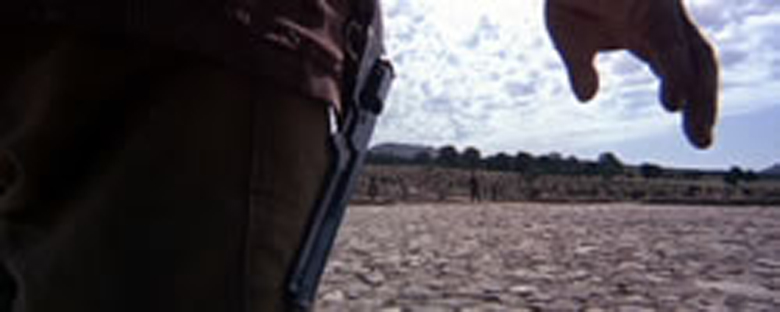
Some time during the mid sixties Roger Corman gave director Monte Hellman the money to make two western b-movies, to be shot more or less at the same time. The first was The Shooting, a kind of existential take on the traditional western stereotypes whith Jack Nicholson as a black clad, sociopathic gunfighter and Warren Oates as kind of architypal western hero in the style of Ethan Edwards. Infact, Oates characters paternal relationship with a younger protagonist is like a straight up homage to John Wayne in The Searchers. The Shooting has much of the best things of the traditional hollywood western, while at the same time waving farewell to it. The second film to be made was Ride in the Whirlwind. Made with much of the same cast as The Shooting (minus Oates) and from a script knocked together by Jack Nicholson, it nevertheless marks a drastic departure from its predecessor.

The architypes are replaced with beleivable characters. The incredible dialogue which carries most of the film is a sometimes bareley comprehensible stream of authentic 1870s north american slang and inflections. Watching this film you feel as if you're listening in on the old west, perhaps from an early record. Harry Dean Stanton plays a one eyed bandit called Blind Dick, who's gang robs a stagecoach in the opening scene of the film. They are tracked down and killed by a vigillante mob, who then mistake some nearby cowboys, Wes (Jack Nicholson) and Vern (Cameron Mitchell), for outlaws. Wes and Vern are forced to go on the run and even take a family hostage in order to escape their pursuers, essentially becoming what they where accused of being in the first place. Seemingly then, the film is a comment on subjective justice as a kind of physical embodiment of the 'lawlessenes' of the old west. Jack Nicholson, already one of the great actors, can apparently write too. Ride in the Whirlwind and The Shooting could also be seen as direct predecessors to a later more famous western, The Missouri Breaks, which also stared Jack Nicholson and Harry Dean Stanton (alongside Marlon Brando) and had a similar sense of authenticity and approach to dialogue.
59. The Name of the Rose (1986)
Jean-Jacques Annaud adapted this from a book by Umberto Eco, it's basically a murder mystery set in a remote abbey in northern Italy during the middle ages. It's thickly atmospheric, feeling for the most part like a horror film, Annaud seems to have deliberately chosen the ugliest actors to play the various characters, who in turn have been exagerated to the level of gargoyles. Sean Connery and Christian Slater play franciscan monks who have been sent to the abbey as representatives during a theological conference. As certain monks start turning up dead they soon uncover a conspiracy that reveals corruption in the catholic church itself, represented by an inquisitor played by a demonic looking F. Murray Abraham. It's good, late night fun.
58. The Double Life of Veronique (1991)
57. Satyricon (1969)

Federico Fellini's adaptation of the Roman text by Petronius, the story of Satyricon basically follows the exploits of two Roman men who start out as rivals in a love triangle with a young boy and then end up in a series of misadventures that take them on a kind of tour through Roman society. The original text is basically an attempt by a Roman writer to update, or satirise, the kind of Greek heroic myths in which young men are sent on these long journeys of discovery. In Satyricon however the two protagonists are distinctly un-heroic, and their journey is a chaotic series of mishaps brought about by their initial capture into slavery. In alot of ways this is a typical Fellini movie, lots of scary women with painted faces and the narrative progresses in this kind of dreamlike way, but it seems to take his cartoonish stylisation to a new level. It's a beautiful dream.

I think it's also notable among his films as being an adaptation of a well known work of literature rather than his own story. Usually I think of Fellini as a very autobiographical director who wrote most of his more well known films with a kind of confesional quality. This is apparent in what are arguably his three most famous films: 8 1/2, La Dolce Vita and Amacord (which translates as I Remember). The only other story that I'm aware of him adapting would be his 1976 film of Casanova's memoirs. Satyricon has something of the same atmosphere as Casanova, as I've said before it's very visually exagerrated, as if the further back he goes historically, the less 'realistic' he's prepared to be. Perversely, this can also add to the veiwers historical curiosity, a curiosity Fellini reveals himself in a film he made not long after Satyricon, Fellini's Roma.
56. Tokyo Story (1953)

Yasujiro Ozu's Tokyo Story is perhaps one of the greatest human dramas ever made. It's about the generational divide and the certainty of change and eventually death, set against the backdrop of what was apparently a transitional period for Japan in the early fifties. Ozu is well known for his family drama's and his distinctive visual style, the kind of odd low camera angles and tendency for filming actors straight on so that they are almost talking into the camera. The audience experiences the story as if a participant, first hand. Ozu himself is a slightly mysterious character. He seems to have rareley, if ever, given interviews. Ozu comes from the generation of directors who basically taught themselves how to make films from just watching movies, and apparently he spent much of his formative education in the cinema instead of the classroom. He was eventually expelled from the boys school he attended for sending love letters to a fellow student, so its possible he was a homosexual, a huge taboo in the Japan of the twenties. In Early Summer, a film he made a few years before Tokyo Story, the subject of arranged marriages is dealt with with vaguely homoerotic undertones. Like Tokyo Story and another film called Late Spring, Early Summer follows the character of Noriko (played as always by Ozu's muse, Setsuko Hara), a twenty something who is presurised to marry by her family. During the course of the story she is forced to decide whether she even wants to marry anyone. She remains reluctant untill almost the end of the film, and when she does finally choose a man it seems to be mostly because of his friendship and apparent loyalty to her dead brother (the war is never far away). No romantic melodrama here. The scene in which she asks his mother for her consent seems bizarre, as if she's asking his mother to marry her instead of him. The theme of repressed homosexuality is subtle but it's there. Tokyo Story was the last in this 'Noriko Trilogy', and I think the most succesful in achieving a sense of genuine pathos with the character's. In this film Noriko is a war widow who's relationship with her dead husbands parents is much deeper than that of their real children. The drama is understated as ever, but seemingly all the more poignant. The plot of Tokyo Story is episodic, like real life. One of the most distinctive things about Ozu's films is his sense of this kind of simple beauty in the cinematography, particularly in his famous establishing shots, and also his sense of rythm in the editing, it's just really well made, pure filmaking.

55. Hardware (1990)

Richard Stanley's horror sci-fi debut, Hardware is a cult oddity, crafted from elements of eighties's classics like The Terminator, Alien, Blade Runner and Mad Max. As an amalgamation of these films, it seems to represent a kind of quintessential eighties sci-fi action movie, with an added influence of the european horror films of Bava and Argento. In the comentary of the Optimum dvd release Stanley even admits to the film being "..a rip off of Terminator and Alien", it seems as if this was Richard Stanley trying to appease movie producers as much as the immagined audience. It was never more than a cult hit, this may be dew to the emphasis on dialogue and character development and lack of action in the first half. Hardware has some of the slow burning elements of a John Carpenter movie like The Thing or Assault on Precinct 13. Like Rio Bravo for the MTV generation. When it reaches its climactic second half the violence is concentrated and brutal, the film kind of explodes. Some of the eye gouging and various other things were cut out on it's initial release, and there are some other sequences that have stayed with me since I saw it when I was 11. The plot is looseley adapted from a story in the comic weekly 2000 A.D., about a homicidal skull faced robot called The Mark 13 that goes on the rampage through a post apocalyptic urban slum of the future. The use of eighties rock songs like P.I.L.'s The Order of Death and Iggy Pop's Cold Metal seem fitting and are well placed. More music by bands like Gwar and Ministry add to the film's gothic industrial aesthetic. Also of interest are the cameos: Fields of the Nephilim singer Carl McCoy plays an enigmatic "zone tripper", Lemmy from Motorhead appears as a taxi driver and Iggy Pop's voice is heard as a radio personality called Angry Bob. Bob's rants at the beginning and end of the film serve a narrative purpose, establishing first of all the context of the story, and finally the outcome in a kind of verbal epilogue, giving the feeling of a medieval play. It's certainly as violent and existential as any work of Shakespeare.
54. Immoral Tales (1974)

Walerian Borowczyk's Immoral Tales is one of the most famous erotic films of the seventies, but it has a dreamy quality and sense of the surreal that sets it apart from films like The Story of O and Emmanuelle. Immoral Tales is made of four segments, which regress cronologically, starting on a French beach in the present day and ending in fifteenth century Rome. The film is obviously about sex as sin. All the characters missbehave by the standards of their time, and seem to get worse as we go on, as if we are regressing also in a moral sense. Borowczyk's film seems to imply that morality itself is relative. The earlier scenes are atmospheric, closer to todays reality and more subdued. The later stories are presented rather more dramatically. The Countess Bathory segment is perhaps the most interesting and memorable, filled with surreal images. Paloma Picasso's performance as Elizabeth Bathory is detached and somewhat menacing. The Borgia family in the final segment are presented as the ultimate symbol of corruption, their incestuous relationships are a subversion of the family, in the Catholic Church in which the family is an important symbol of the relationship between man and God. It seems as if the more repressed the time and place the characters are from, the more corrupt they infact become, and sex and sensuality are represented as all the more enjoyable for being 'wrong'. The characters are not judged or punished by Borowczyk, they are shown objectively, as if specimens in a zoo.

53. Death in Venice (1971)

52. Tenebrae (1982)

Tenebrae is Dario Argento's last great giallo, it's also probably my favourite film of this much underrated genre. It's an incredibly violent film, almost all the characters are eventually killed, but as always the deaths are beautifully elaborate, his style is indesputable and very Italian. I particularly love the fact that in one scene a young girl is chased into the path of her killer by an over enthusiastic doberman, a cruel twist of fate typical of Argento's films. His characters often die in the most unlucky ways. Daria Nicolodi, the mother of Argento's daughter Asia, was often the brunt of these sadistic ironies: in Terror at the Opera she's not only shot in the head but through the eye. In Phenomena she's mauled by a razor weilding chimpanzee. In the climax of his early giallo, Cat o' Nine Tails, the murderer receives their comupence by falling down a lift shaft (after being shot) and on the way down burns their hands trying to hold on to the lift cable. He seems to like making his characters suffer, beyond what is required. Argento's violence is literally excessive.
51. 3 Women (1977)
 By far Robert Altman's most disturbing and strangest film, 3 Women is a schizophrenic nightmare. Millie (Shelley Duvall) and Pinky (Sissy Spacek) share an appartment and work together at a health spa. They are both archetypes. Modern girl Millie is outgoing, sexually confident and shallow. Pinky is a country girl, shy and childlike. The appartment complex they live in is owned by an older woman, Willie (Janice Rule) a pregnant artist who paints horrific murals, depicting ferral, ape like creatures. The two younger women are also sporadically bothered by Willie's over sexed husband, Edgar. The three central characters are so exagerrated, Duvall and Spacek are clownlike.
  Millie, Pinky and Willie all seem to exist apart from their surroundings and are treated with indifference and sometimes hostility. By the end of the film the three women have swapped roles to the extent that it suggests that they are merely facets of the same woman. In this sense it's similar to Bergman's Persona. This idea is more blatantly suggested in the ending which is horrific and mysterious.