Thursday, 14 February 2013

Even More of The Greatest part 4

More of my favourite films in no particular order.


90. Beau Travail (1999) Claire Denis' semi abstract, homo-erotic masterpiece, Beau Travail depicts life in a French Foreign Legion garrison in north Africa. Denis Lavant plays Sgt. Galloup, a career soldier in charge of a number of young men, recruits from various parts of the globe. When a charismatic and handsome soldier called Sentain arrives, Galloup feels envious of his popularity with the other men and begins to resent him for his apparent bravery and strength of character. In the end Galloup's jealousy and obsession with Sentain leads to his court martial and the end of his career in the legion. The ambiguous ending seems to suggest Galloup's suicide. The simple story, loosely inspired by Herman Melville's novella Billy Budd, is told with little dialogue, the emphasis is on abstracted images and sounds, edited together rythmically. The effect is hypnotic. Denis' direction also emphasises the homo-erotic context, and seems to suggest another reason for Galloup's fixation.


89. Bad Boy Bubby (1993)
I remember seeing the trailer of Bad Boy Bubby when I was around 13 (when it came out) and being completely gobsmacked. It didnt look like anything else. It has nearly everything a teenage boy would want in a film: a retrobate anti-hero performing various acts of social suicide/destruction. Doing all the things you wish at the time that you could. You've never been drunk enough yet to surpass them, you've never felt that morning after regret. In a sense, coming of age is what Bad Boy Bubby is about. Rolf de Heer's film, about a man called Bubby (played by Nicholas Hope) who is trapped from birth in a small apartment by his deranged mother until he one day escapes and runs amok, was made in an experimental way, using tiny microphones under Hope's wig in order to record 'Bubby's experience', and also using 31 different directors of photography. In order to tell Bubby's story it would have to look and sound completely new. The childlike Bubby's adventures are episodic. He joins a band, discovers pizza, and is frequently taken in by sympathetic onlookers who try to mold him into various guises of middle class acceptabilty, or just themselves, it doesn't work. He is, offcourse, irrepressible. A dirty mirror to hold up to ourselves, he lets us see what we are. Bad Boy Bubby remains one of the most original and, in the end, absurdly touching films of the 90s.


88. Record of a Tenement Gentleman (1947)
Another great example of Yasujiro Ozu's subtly moving and rather beautiful drama films (see Tokyo Story at #56), Record of a Tenement Gentleman is a darkly comic, but no less poignant snap shot of post war Japan. The story concerns the residents of a Tokyo slum that has been damaged during the bombing raids of the 1940's. All the characters are destitutes. Tashiro (played by Ozu regular Chisu Ryu) makes a living in the street telling peoples fortunes. One day he meets a young boy who has apparently been abandoned by his father. Taking him back to his tenement, he tries to persuade his neighbour, Tamekichi, a pots and pans seller, to take the boy temporarily until they can locate his dad. Tamekichi refuses and tells Tashiro to try another neighbour of theirs, a widow named O-tane. Although she is reluctant, O-tane eventually agrees to let the boy stay one night. Told with Ozu's trademark distinctive visual style, using establishing shots to punctuate scenes, this 'beauty of the every day' is what sets Ozu's films apart, and seems somehow very Japanese. The film has a certain pace which keeps us detached from the characters. No melodrama, nothing is confronted quite head on. As with other masters like Bergman or Tarkovsky, in Ozu's best work (of which Tenement Gentlemen is certainly one) one can feel the presence of genius from the outset. These are the films that are the easiest to sit through because, like all great art, they elevate you. It is cinema at its most life enhancing.


87. Jean de Florette/ Manon des Sources (1986)
Claude Berri's classical two movie adaptation of the novel by Marcel Pagnol, the films were shot in succession and tell the story of two perversely immoral 'salt of the earth' farmers in early 1920's Provence, and their attempts to cheat a naive Parisian out of his inherited land. Ugolin (played by Daniel Auteuil), a dim witted war veteran, returns from World War 1 to his small home town and his elderly uncle Cesar (Yves Montand). Eventually Ugolin reveals to his uncle that, instead of a typical crop, he wishes to grow carnations. At first Cesar is sceptical, but agrees to help his nephew when he realises how much money can be made. They approach a local farmer to see about possibly buying his land, as the scheming Cesar knows of a spring, one that he buried years earlier, that will make this land more fertile. The farmer, who is ignorant of the springs existence, nevertheless refuses and during an altercation with the two prospective buyers he is accidentally killed. After making it appear as if the farmer simply fell from a tree, Ugolin and Cesar scuttle away to bide their time. They learn that the farmers only living heir is a Parisian tax collector named Jean (Gerard Depardieu). Since, as they learn, Jean is a hunchback, it seems unlikely he will want to keep the farm, nevertheless Cesar resorts to breaking the roof tiles in order to attempt to make it as unappealing as possible. Unfortunately for both Cesar and his nephew, Jean has every intention of keeping the land as he intends to breed rabbits. He also wants to bring up his young daughter in the countryside, which he has somewhat idealised. So begins a darkly humourous and ultimately tragic saga. Jean de Florette heralded a fashion for nostalgic period films that would become the norm in French cinema until the release of La Haine in 1995. Berri's adaptation is classicaly and impeccably directed.


86. JFK (1991)
Oliver Stone's epic re-telling of the assassination of President John F. Kennedy, JFK is essentially an engrossing mystery thriller, but with a disturbingly real context. Stone's only real claim in the end is that the assassination was a conspiracy orchestrated from somewhere within the American government itself, a prospect which may have seemed far fetched at the time the film was made, but which in a contemporary context is beginning to look more and more believable. The sheer amount of information delivered through this film, some of which is fairly chilling, also give it the feel of a some sort of historical document. In this sense it has something in common with Goodfellas, the film Martin Scorsesse made only a year earlier about life in the mob. Both films seem to stem from some prevailing trend in the early 90s towards the informative. Something which told us how it really was. Stone wrote the screenplay of JFK based on two books: On the Trail of The Assassins by Jim Garrison (who Kevin Costner plays in the film) and Crossfire: The Plot That Killed Kennedy by Jim Marrs. Stone also met with L. Fletcher Prouty, a former Chief of Special Operations under Kennedy who became a public critic of United States foreign policy, and particularly of the activities of the Central Intelligence Agency. Stone said meeting Prouty was one of the most extraordinary afternoons of his life and it was one of the inspirations of the scene in which the character of Garrison meets a former Pentagon Colonel called 'Mr X'. In the film this character explains to Garrison many things which seem to put the theory of a government conspiracy beyond a reasonable doubt, it is one of the great payoffs in Hollywood history and something of a verbal climax to a film which is infact structured as much like an old fashioned whoddunit as a documentary. JFK is perhaps the perfect amalgamation of the two.


85. The Ipcress File (1965)
Surely one of the greatest British films ever made. Sidney J. Furie's adaptation of Len Deighton's spy novel The Ipcress File is also one of the most inventively directed films of the 60's. The camera is frequently watching the scene from some unexpected angle, from behind a phone box or even from inside a lamp shade, the characters in the story are 'under surveilance' from the audience. Michael Caine plays Harry Palmer, a low level intelligence agent working for the Ministry of Defence in London. In contrast to a character like James Bond, Palmer is an insubordinate cockney who enjoys classical music and cooking. He has been recruited to the Ministry from a military prison in which he was incarcerated. All the Palmer films (see also Funeral in Berlin and The Billion Dollar Brain) begin with Palmer reporting to, or being seeked out by, his boss Colonel Ross. To contrast Palmer, Ross is an archetypal English gentleman, one of those elite 'old boy's' that once seemed to exist in Britain, and perhaps still do in some form. He attends a club, wears bowler hats and always has an umbrella. Ross' contempt for Palmer's unusual sense of humour and general insubordinate manner is offcourse comical, but these scenes are where Palmer's character burns the brightest. He appears to wear a mask of smirking indifference, and remains incredibly enigmatic. Although Palmer is sometimes forced to act amorally, he seems to ultimately mean well, and exudes a kind of understated heroism.
When a famous scientist called Dr Radcliffe is abducted, Palmer is re-allocated from his usual surveillance duties to the clandestine government department that was responsible for Radcliffe's security escort: an agent who was killed during the abduction. Palmer's journey is a cerebral one, there is a mystery to unravel. No action set-pieces, no exotic destinations (in this film atleast), just cold violence and a lot of paperwork.


84. She Wore a Yellow Ribbon (1949)
In this classic John Ford western, John Wayne plays Capt. Nathan Brittles, an ageing officer of a small and remote U.S. cavalry outpost. The story unfolds over the course of his last week of active duty before his retirement. It is in the immediate aftermath of General Custer's defeat and a group of young Native Americans are seemingly running amok and threatening to attack the fort, which also houses a small number of women. The subject matter is similar to Ford's later and more well known western The Searchers, in which Wayne also appears in his usual macho persona, but this film seems altogether less pompous. She Wore a Yellow Ribbon is far less epic in scale and the story is relatively simple, more down to earth somehow. Thankfully, its depiction of Native Americans is also slightly less controversial. For a start the Native Americans in this film are played by actual Native Americans, instead of the conspicuously blue eyed and pink skinned character actors of The Searchers (and in fact so many other westerns). While there still remains a rather embarrassing lack of the Native point of view (Custer's defeat and slaughter was arguably justified), nevertheless the film does seem to at least attempt to show the Native population as a complexed society. Throughout the film Brittles remains on good terms with the elders of the tribes, who are represented in one scene by the character of Chief Pony That Walks (memorably played by Chief John Big Tree). Though its a film most definitely of its time in many ways, She Wore a Yellow Ribbon is nevertheless a complexed and beautifully shot western from a director who is after all one of the key figures in the genre, and indeed in American movies.


83. Unforgiven (1992) From classical westerns to the modern kind, of which Unforgiven is possibly the greatest example, this is essentially a film in which the real MYTHOS of the old west is celebrated. The story telling and word of mouth culture of the time is explored here more than anywhere else. The whole film is essentially a series of anecdotal monologues and dialogue scenes which are convincingly authentic. There is comparatively little action, as it should be in any self respecting American western, the majority of the film is a slow build to some terrible climax you know is coming. Clint Eastwood plays William Munny, an ageing ex-outlaw gunman turned farmer who is persuaded to return to his former life for one last job. A group of prostitutes, led by 'Strawberry Alice' (played by Frances Fisher), have raised 1,000 dollars for a bounty on a couple of cowboys who attacked and disfigured their colleague Delilah (Anna Thompson). Promptly, a young wannabe gunfighter, 'The Schofield Kid' (Jaimz Woolvett), arrives at Munny's farmstead to convince him to help track down the two men and share the reward. Munny refuses but is eventually convinced it is the right thing to do after hearing a rather exaggerated account of their crime from Schofield. Munny then convinces his old partner Ned Logan (Morgan Freeman) to help them by recounting an even more exaggerated version of the incident, and the three men set off. Meanwhile, another reformed gunfighter, 'Little Bill' Daggett (Gene Hackman) is now the over zealous sheriff of Big Whiskey, the town where the pivotal event took place. Daggett was originally lenient on the two cowboys, and enforces a 'no gun' policy as a peacekeeping effort, but also to ensure he has absolute power over everyone in the township. He is soon shown to be a narcissistic bully. Eventually Munny and his compadre's track down and kill the two cowboys and claim the reward, but after Logan leaves Munny and Schofield to return home, Daggett captures him and has him tortured to death. This incurs the wrath of Munny and awakens a dark side that has long been dormant. Clint Eastwood's 16th feature film as director is a powerhouse of American storytelling, and proof that in 1992 Hollywood could still do 'dark' when it had to.


82. The Shining (1980)
Stanley Kubrick's masterpiece is light on gory violence and heavy on atmosphere and suspense. It's a story (adapted from Stephen King) that merely presents the audience with a situation, a man alone with his family in a remote mountain hotel, and then lets this situation fester and evolve into a nightmare. Jack Torrance (played by Jack Nicholson) is a frustrated writer who decides to become the winter caretaker of The Overlook Hotel, a mountain resort that is closed to the public once a year dew to extreme weather conditions. He takes his wife and young son with him to live there while he plans to use the peace and quiet to write his book. His son, Danny (Danny Lloyd) seems to have some psychic ability which manifests itself through an imaginary friend called 'Tony'. Before arriving Danny tells his mother, Wendy (Shelley Duvall), that Tony doesn't want to go to the hotel. After they arrive Danny starts to suffer from terrifying hallucinations. Meanwhile, inspiration seems to elude Jack and he slowly goes insane, eventually adopting the persona of a previous caretaker who apparently killed his family and then himself years before. Nowhere has an atmosphere of disquieting menace been so completely achieved as in The Shining, arguably Stanley Kubrick's greatest film, and in my opinion, the greatest horror film of all time.


81. Once Upon a Time in America (1984) Sergio Leone's sprawling gangster epic, based on the semi-autobiographical book The Hoods by Harry Grey, tells the story of the rise and fall of a group of childhood friends. The film follows them from their childhoods as impoverished Jewish immigrants in early 20s New York, to success in the criminal underworld of the prohibition era, and finally to a mysterious reunion many years later. It encompasses a transitional period of the 20th century, rarely has the past juxtaposed with the present so much as when Robert De Niro's character, 'Noodles', looks back from the 70s to the early 20s. This is how the story begins. The film is completely and utterly about nostalgia. Noodles, played as a kid by Scott Tiler, remembers Deborah (Jennifer Connelly and Elizabeth McGovern), the precocious sister of his friend Fat Moe (Mike Monetti/ Larry Rapp). He watches her practicing ballet through a peephole, this image is our doorway back, as if it is his earliest important memory. The romantic, childish love they feel for each other will provide the emotional core of the movie. Soon Noodles meets Max (Rusty Jacobs/ James Woods) and they become life long friends and business partners, until eventually falling out. Noodles disappears after Max and the rest of his circle are killed in a fire. Then 40 years later Noodles receives a mysterious letter. Leone's original version of the film was about 4 and a half hours long, but he edited it down himself to about 3 and a half, and this became the version that is now most commonly seen. On its American release however, and against Leone's wishes, the studio cut it down to about 2 and a half hours and re-edited it so that the story unfolded completely chronologically. Consequently, this version received poor reviews and Leone was apparently heartbroken. He never made another film, but for most people the European cut of Once Upon a Time in America is a true masterpiece, and a fitting swansong to a director who in his brief career had such a unique impact on cinema.

Wednesday, 28 November 2012

Even More of The Greatest part 3

My list of favourite films continues in no particular order.


80. The Apple (1998)
Directed by Samira Makhmalbaf when she was just 17, The Apple is based on the true story of twins Massoumeh and Zahra Naderi, who were imprisoned at home by their father until the age of 11. The films cast was made of non-actors and infact the girls and their family appear as themselves. The seemingly eccentric father of the two girls could have been depicted as an opressive monster, but instead he is imbued with genuine pathos. The dialogue was improvised according to a script co-written by Makhmalbaf with her father Mohsen (an acclaimed director in his own right). The episodic story, and the distinctive cinematography of Ebrahim Ghafori, give the film a symmetry and beauty. A true story told through visual poetry, the film also seems to be a fable with the apple of the title as the fruit of knowledge.


79. Come and See (1985)
Elem Klimov's iconic movie about the Nazi invasion of Belarus during the second world war, Come and See is as harrowing as it is beautiful. The war is abstracted, reduced (or perhaps elevated) to a seemingly endless prossesion of images which are unforgetable. Its a profoundly visual film. The title of the movie seems apt, although its also a reference to The Book of Revelations ("I heard the voice of the fourth beast say, Come and see. And I looked, and behold a pale horse: and his name that sat on him was Death, and Hell followed with him. And power was given unto them over the fourth part of the earth, to kill with sword, and with hunger, and with death, and with the beasts of the earth").
The story is told, or rather shown, from the perspective of a boy, Florya, who is apparently just old enough to join the Russian resistance forces against the Germans. At first he is eager to join, but soon becomes disillusioned and eventually completely broken by the violence and atrocities he witnesses and barely survives. The intensity escalates until its final harrowing climax which is essentially a vision of hell. In the end Florya is a different person, a hardened soldier, but he is also a civilian. His face seems to represent all the victims of war, particularly of THAT war.


78. Love Exposure (2008)
Cult director Shion Sono's four hour epic on the human condition and the nature of love has to be one of the greatest films of modern times, and certainly of the 21st century. This is a love story with a unique religious context, that of the Catholic Japanese. Its a film so long, and so full of ideas, that its hard to remember everything that happens and in what order, its a bit like trying to recount the last ten years of your life to a stranger. The plot is fairly bizarre. Yu is the son of a priest who falls in love with his step sister, Yoko, whom he sees as the Virgin Mary.
Yoko, however, seems to regard Yu with disdain. She is infact a lesbian, and in love with her adopted mother, Yu's step mother, Keiko. During the course of the film, and for various reasons, Yu finds fame as an 'upskirt' porn photographer and also creates a female alter ego whom Yoko falls in love with, not knowing that its him. With the arrival of the mysterious Aya, the head of a sinister cult known as Zero Church, and who has become strangely infatuated with Yu, things start to take a darker turn as it becomes a love triangle of rejected youth. Love Exposure left me emotionally drained. At times incredibly sad, but also very funny.


77. Weekend (1967)
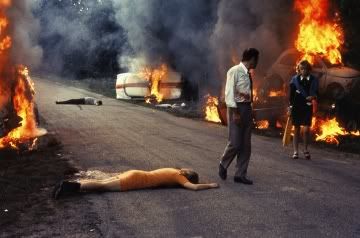
Jean-Luc Godard's Weekend is essentially the story of a journey through the French countryside, but unlike other road movies the protagonists are not rebels or outcasts, but merely a modern, outwardly respectable, bourgeois Parisian couple. Roland and Corinne are a husband and wife who are both having affairs and plotting the others murder. They decide to visit Corrine's wealthy father in the country in order to murder him and stop him from changing his will. So begins their 'Weekend'. From the very outset of the film motorists are shown in conflict with one another. The characters of these early scenes also seem outwardly respectable: affluent, even glamourous, white Parisians, but their behavior is distinctly base. Animalistic. They behave excessively with each other, either through violence or verbal abuse, to the point of absurdity. These occurrences seem to intensify in the country, which is apparently abundant with car accidents and bloody fatalities, to a point verging on apocalyptic. After the couple crash and write off their own car, they attempt to flag down a car. The driver confronts Roland with a question, "Are you real, or in a film?" to which Roland replies "in a film". The man in the car drives away exclaiming "you lie to much!". Eventually they are captured by some hippie cannibals and Roland is eaten. Corrine joins them and seems nonplussed by the death of her husband. Godard paints a picture of the French class struggle, and in particular depicts the French middle class as terminally shallow and materialistic. The irony is that these are the very people who would probably end up watching the film. Godard is perhaps laughing at himself as much as anyone else.


76. Shogun's Samurai (1978)
A masterful example of samurai melodrama by veteran director Kinji Fukasaku, Shogun's Samurai takes place after the death of the second Tokugawa shogun in 1623, and concerns the subsequent struggle for power between his two sons, the stammering, birth-marked heir Iemitsu, and his younger brother, the popular and benevolent Tadanaga, his fathers favourite. Various factions choose their side and what results is a hugely entertaining, if largely fictional account of a war of intrigue and political machinations during an established historical period. What it lacks in historic accuracy it makes up for in atmosphere and high drama, the plot is practically Shakespearean. So many characters and sub plots emerge, the story eventually takes on a truly epic scale, until a final, violent and satisfyingly dramatic climax. Whether it happened is unimportant, its a great story, and brilliantly acted by the cast which includes Toshiro Mifune and Sonny Chiba.


75. The Spirit of the Beehive (1973)
This uniquely touching film by Spanish director Victor Erice, has to be one of the greatest ever made about a childhood. Ana is a small girl living in a Spanish town just after the civil war (sometime around 1939). She spends much of her time with her sister Isabel, who is slightly older and has told her about a mysterious 'spirit' who lives nearby. Ana's imagination attributes this spirit to Boris Karloff's Frankenstein, from the James Whale film which has been shown in the town's improvised cinema, and later to a Republican soldier she encounters, who is on the run from Nationalist forces, now the established power in the country. Post civil war Spain is shown abstractly through the eyes of these two sisters, who are offcourse quite innocent and oblivious to the political climate of the time. The issues are therefore tackled with a degree of subtlety, which allowed the film to be made in the early 70's, the waning days of this same oppressive regime that had existed since the war.


74. Mother and Son (1997) The first in acclaimed director Alexander Sokurov's cycle of films dedicated to platonic, familial love, Mother and Son is in intensely original and unique work of cinematic art. The film features only the characters of the title, a mother and son. The mother appears to be gravely ill, and the son is her carer. There is no geographical or chronological context, it is unclear where they are or when it is, the only suggestion of a world outside them is the occasional sight of a steam train, and later a sailing ship, both seen from a great distance. Their relationship seems therefore magnified. Sokurov stretched the film so that the images are distorted, and sometimes the lens even seems dirty or smudged with water, creating blurs in the frame. It looks and feels like nothing else. Surely one of the most beautiful films ever made.


73. Mirror (1975)
Andrei Tarkovsky's most personal film, Mirror is a partially autobiographical account of Russian life from the 30s, until the 70s when the film was made. The three periods of pre-wartime, wartime and post-wartime Russia are represented un-chronologically, in a series of flashbacks, archive footage and present day scenes and seemingly abstract, dreamlike sequences which are visually startling even by Tarkovsky's standards. All jumping back and forth in the life of Alexei, the films protagonist, as if in a process of thought. The present day scenes are infact shot subjectively, looking out from inside the protagonists head, his adult face is never seen, but his voice, the voice of the narrator, is heard throughout the film. Margarita Terekhova, who plays Alexei's mother during the childhood scenes, also plays his ex-wife in the contemporary ones, and the young actor who plays Alexei as a child in the 30s also plays his son in the 70s. Alexei's mother in the 70s is played by Tarkovsky's own mother. Despite all of this, the film is never indulgent. On the contrary, its astonishing originality and style are strangely moving. Its a film which manages to be at once intensely personal and subjective, and yet also somehow universal.


72. Pather Panchali (1955)
The startling debut feature of Satyajit Ray, who would go on to become the most prominent Bengali film maker working outside the bollywood system, Pather Panchali's beauty is in its story and incredible pathos. It was adapted from a novel by Bengali author Bibhutibhushan Bandyopadhyay, and is the first part in what would become known as 'The Apu Trilogy' after Ray also adapted the novel's sequel into two more films: Aparajito (1956) and The World of Apu (1959). The story of Pather Panchali concerns an impoverished writer's family living in their dilapidated ancestral home in rural Bengal, and in particular his young son, Apu. As his father is often away trying to find work, Apu grows up around three women. His elderly aunt, his mother and his older sister, Durga. He is particularly close to his sister, they seem to experience everything together, they're a team. The movie is probably one of the earliest examples of a film telling its story exclusively from a child's perspective (along with Yasujiro Ozu's 1932 film I Was Born, But...), and undoubtedly one of the most touching and beautiful. Although its set in the 1920s, the only hint that we are in the recent past is in Durga and Apu's astonishment at the telephone lines and steam train they encounter in one of the films most iconic scenes. A profoundly moving and ultimately tragic story told with exceptional style by Ray, Pather Panchali is in my opinion one of the greatest films of and about the 20th century.


71. The Deer Hunter (1978)
The Deer Hunter is simply one of the greatest American films ever made, and truly one of the greatest films ever about blue-collar American life, its dreams and hardships. Examining the impact of war on a small group of friends from a working class, Russian-American community, it is also certainly the most subtly moving film to be made about the war in Vietnam. The cast is essentially a who's who of 70s method actors. Mike (Robert De Niro), Stan (John Cazale, in his last role), Nick (Christopher Walken), Steven (John Savage) and Axel (Chuck Aspegren) are childhood friends who all work in a steel refinery in Clairton, a small town in western Pennsylvania. The movie opens on the evening of Steve's wedding. These are the last few hours of their adolescence. High school photographs of Mike, Nick and Steve are hung up at the wedding reception along with a banner reading "Serving God and Country Proudly". They have all signed up for Vietnam and are dew to be shipped out soon. Gradually their individual characters are introduced. Mike is a sort of quintessential Russian male, stoic and overtly masculine. His best friend, Nick is a sensitive, slightly introverted individual. From the start he is the most detached of the group. Steven is a hen-pecked mothers boy. Stan an extroverted and slightly erratic ladies man, and Axel is the hard drinking, life and soul of the party. The characters are so beautifully drawn by writer director Michael Cimino, and perfectly interpreted by the cast, and this is ultimately what makes the film so engaging. After Steven's wedding, the rest of the guys, along with another friend, a piano playing barman called John (George Dzundza), decide to go hunting for deer. Mike reveals his ethos of 'one shot' in regards to deer hunting. "One shot is what its about. Two shots is pussy." The wedding and hunting sequences at the beginning of the film are the last time all the characters are together, the last time they are happy. After the war everything will be different. The films second act takes place in Vietnam. Mike, Nick and Steve are captured by the Viet Cong and forced to play Russian roulette. The resulting scene is perhaps one of the most succinct portrayals of the life and death situation in war. During the third act, when Mike eventually returns, alone, to the community they all grew up in, he and Nick's sweetheart, Linda (Meryl Streep) take solace in each other and seem to bond over their love for Nick. All in all, a subtle and beautifully structured masterpiece.

Sunday, 12 February 2012

Even More of The Greatest part 2

More of my favourite films in no particular order.


70. The Swimmer (1968)
The Swimmer, adapted from a short story by John Cheever and directed by Frank Perry and Sydney Pollack, is the story of middle aged advertising executive Ned Merrill (Burt Lancaster), who after visiting some friends decides to swim home via a "river" of swimming pools provided by his friends and neighbours: the New England, suburban social elite. After appearing unexpectedly from behind some foliage wearing only a pair of swimming trunks, he is welcomed warmly at first by close friends. It seems he's been away for a while, and apparently missed. When he reveals his plan it's taken with a pinch of salt, Ned is always the life and soul. As the journey progresses, each pool introduces another set of characters revealing different aspects of his past, and the at first vital and charismatic Ned is soon shown to be a man in extreme denial. This great story, adapted by Eleanor Perry (Franks wife), makes for one of the most interesting screenplays to come out of Hollywood in the 60s. Ned lives in the same world as Mike Nichols' Graduate, but he's looking at it from over the proverbial hill. Consequently, it's a much more cynical look at the American dream and its distinctive class system, which it subtley undermines.


69. La Terra Trema (1948)

Luchino Visconti's La Terra Trema is a masterpiece of world cinema and a shining example of the Italian neo-realist movement. It's a film about the exploitation of fishermen by ruthless wholesalers in a small coastal town in rural sicily. This subject is tipified by the plight of the Valastro's, a traditionally large and empoverished family of fishermen. The Valastro family were played by non actors, some of whom were actually related to each other, and all from Aci Trezza, the town the film was shot and set in. They seem to be playing themselves in their own story. This, and the deep, re-assuring voice narrative make the film seem almost like a documentary and it seems to embody in some way the spirit of Italian neo-realism. The tragic and complexed story is told partly through the beautiful cinematography, and its full of images that are unforgetable and iconic. The incredible beauty in this film is enhanced by its realness.


68. Short Cuts (1993)

Robert Altman's magnum opus, Short Cuts is an epic three hour journey through the lives of a collection of over twenty main characters, played by an all star cast including: Tim Robbins, Matthew Modine, Jullianne Moore, Fred Ward, Andie MacDowell, Lili Taylor, Jennifer Jason Leigh, Robert Downey Jnr., Chris Penn, Madeleine Stowe, Lily Tomlin, Tom Waits and Jack Lemon. Adapted from the short stories of Raymond Carver, each characters stories meet and intermingle in different ways, the characters are all connected. The extent to which is offcourse only apparent to us, the audience. Seemingly, Short Cuts is a film about fate and chance, the things that affect us that we're not aware of. It's a film starring everyone, about everyone.


67. Mad Max (1979)


66. The Last Picture Show (1971)

Based on the book by Larry McMurty, Peter Bogdanovich's epic coming of age drama is one of the greatest ever to come out of Hollywood, influencing a generation of American arthouse films like Rumble Fish, The Outsiders and American Graffiti. It's episodic plot is told simply and beautifully in cold black and white, the harshness of the photography and the mono sound makes the film seem stripped down, older than it is, even of the early 1950s in which the story is set. Infact it was made twenty years later. Sonny Crawford (Timothy Bottoms) and Duane Jackson (Jeff Bridges) are two high school footballers living in a dying town in west Texas. Virtually everything that happens there centres around the diner, cinema and small pool hall all owned by Sam the Lion (Ben Johnson), an older, stetson wearing Texan archetype and father figure to both boys. Cloris Leachman won an oscar for her portrayal of Ruth Popper, the unhappy wife of the local football coach, and Cybill Shepherd is also great in her debut as the beautiful but selfish town princess Jacy Farrow.


65. The Ninth Gate (1999)

This is one of my favourite Polanski films, perhaps its not as celebrated as Rosemary's Baby, Chinatown or Frantic, but neverhteless its a film I end up re-visiting alot. I think its one of the most watchable and atmospheric of all his films, an example of a master at the peak of his ability. Adapted from the novel El Club Dumas By Arturo Perez-Reverte, the story incorporates horror and occult themes into a mystery thriller. Dean Corso (Johnny Depp) is a ruthless, rare books dealer motivated solely by profit. One day a client, the publishing mogul and rare book collector Boris Balkan (Frank Langella), explains to Corso that he has acquired one of the only three existing copies of The Nine Gates To The Kingdom Of Shadows, a 16th century book written by an occultist who was burned at the steak for heresy. Balkan believes that his copy is a forgery however, and recruits Corso to go to Europe and acquire the other two copies at any expense, or by any means. The rusult is a thoroughly enjoyable, mystery adventure with ample helpings of the absurd, something which Polanski has a natural instinct for, and is counterbalanced by Depps unusually subdued performance. It's a film where the absurd and the unsetling often overlap.

http://www.youtube.com/watch?v=bTEZ2Cf0ngQ


64. La Residencia (1969)
La Residencia a.k.a. The Boarding School or The House That Screamed, is a Spanish gothic horror film directed by Narciso Ibanez Serrador, legendary writer director of Who Can Kill A Child? As the title would suggest, its set in a boarding school, a girls boarding school in France some time around the late 19th century. The story, written by Serrador, is a masterpeice of macabre subtletey and imagination. Revolving around the murders of five of the girls by an unknown assailant, the plot is full of twists and strange dissjointed scenes that set it appart from most horror films of the time. It also features a number of incredibly well drawn and very sinister characters, including the manacing and sadistic head girl Irene (played by Mary Maude), the stern disciplinarian head mistress Madame Fourneau (Lilli Palmer) and her voyeristic teenage son Luis (John Moulder-Brown). Serrador's direction is impeccable, the film looks beautiful and is incredibly atmospheric. Of his two films this is probably the greater. Good fun and perhaps the only gothic giallo.


63. Parenthood (1989)

In 1989, Ron Howard, ex star of Happy Days and veteran director of family classics like Splash, Cocoon and Willow, wrote and directed Parenthood, his last foray into the genre before the more seriously toned Backdraft in 1991.
Parenthood in many ways is the ultimate family movie, it's actually about the family, and the generational divide. The story revolves loosely around three generations, and three units of the Buckmans. The excellent script deals with what are at times quite moving subjects, but with a subtlety and lightness of tone thats ultimately life affirming. Its simply one of the greatest screenplays to come out of Hollywood in the whole of the 80s. This film also has a great cast, including Jason Robards, Rick Moranis, Dianne West, Mary Steenburgen and most importantly Steve Martin, truly one of the greatest comic actors. Both funny and incredibly poignant, Parenthood is a film to literally make you laugh and cry.


62. The Gospel According to Matthew (1964)
Pier Paolo Passolini's The Gospel According to Matthew (a 'St.' was added before 'Matthew' during translation against the directors will), is truly one of the greatest religious epics ever committed to celluloid. Pasolini was inspired to make it after reading a copy of the New Testament in a hotel room, regarding Matthew's version of the life and philosophies of Jesus as the most appropiate to the cinema. Much of the script that resulted was a more or less exact transcript of what the Gospel of Matthew actually says, none of the words are changed, and virtually no scenes where added for dramatic effect, it seems in part to be a reaction against the Hollywood style adaptation of the Bible. This is also apparent in the restrained visualisation of the miracles and the crucifixion, they are distinctly un-sentimental. Infact, the film is incredibly minimalistic visually, paying little attention to historical authenticity, and seemingly a direct influence on Scorcesse's The Last Temptation of Christ. The film pays some homage to Italian neo-realism, the entire cast consisted of non actors and it was shot in southern Italy rather than the Holy Land. Passolini also used handheld cameras for many scenes, and even zoom shots. His ongoing obsession with the human face seems most un-restrained in this film, especially in scenes with less dialogue (virtually all the talking is left to Jesus himself), and in few of his films are the faces so expressive. Another unconventional aspect of the film is the music. Instead of an original score, Passolini used an eclectic mix of popular and classical music, ranging from Mozart and Bach to Congolese gospel choir Missa Luba, and even the blues standards of Billie Holliday and Blind Willie Johnson. The film seems to be partly about the modern worlds relationship to Christianity, with Jesus as a champion of the peasantry, an angry working class hero. Whats remarkable is that it does this while changing virtually nothing from the Biblical source. The Gospel According to Matthew is one of the most authentic Biblical films, and certainly the most groundbreaking and inventive.


61. Andrei Rublev (1966)
Andrei Tarkovsky's episodic re-imagining of the life of the 15th century icon painter and monk, Andrei Rublev, is both epic in scale and dreamlike. Tarkovsky manages to reflect the serenity and calm of Rublev's art in his camera style, encorporating slow, contemplative tracking shots and images of natural beauty that are simply and profoundly moving. This is juxtaposed in a segment like The Raid, a sequence depicting the sacking of a town by Mongolic 'Tartars'. The Raid is filmed in long continuous tracking shots, making these scenes seem chaotic and giving the feeling of spontaneity. A riderless horse is shown stumbling down stairs during This segment, apparently symbolic of tainted innocence and the chaos of war. Wild or lone horses feature regularly in the films imagery. They seem to also represent the kind of natural benevolence, purity, serenity and perfection apparent in Rublev's art. His paintings seem to conjure the divine.
This is a film made in and for a devoutly religious country, specifically dealing with Russian faith and belief. Other segments of the film include The Fool, Andrei's Passion, The Last Judgement and The Bell. This last segment, in which Rublev is the aged observer of the casting of a huge bronze bell, is perhaps the most moving and a seemingly perfect metaphor for the creative process. This depiction of the creative act is one we share with Rublev himself. In the end he seems to be rewarded with some understanding of the beauty he has given to the poor, suffering people of Russia, and to humanity itself.

Saturday, 14 January 2012

Sunday, 14 August 2011

Even More of The Greatest part 1

As before they're not in any particular order.


60. Ride in the Whirlwind (1965)

Some time during the mid sixties Roger Corman gave director Monte Hellman the money to make two western b-movies, to be shot more or less at the same time. The first was The Shooting, a kind of existential take on the traditional western stereotypes whith Jack Nicholson as a black clad, sociopathic gunfighter and Warren Oates as kind of architypal western hero in the style of Ethan Edwards. Infact, Oates characters paternal relationship with a younger protagonist is like a straight up homage to John Wayne in The Searchers. The Shooting has much of the best things of the traditional hollywood western, while at the same time waving farewell to it. The second film to be made was Ride in the Whirlwind. Made with much of the same cast as The Shooting (minus Oates) and from a script knocked together by Jack Nicholson, it nevertheless marks a drastic departure from its predecessor.
The architypes are replaced with beleivable characters. The incredible dialogue which carries most of the film is a sometimes bareley comprehensible stream of authentic 1870s north american slang and inflections. Watching this film you feel as if you're listening in on the old west, perhaps from an early record. Harry Dean Stanton plays a one eyed bandit called Blind Dick, who's gang robs a stagecoach in the opening scene of the film. They are tracked down and killed by a vigillante mob, who then mistake some nearby cowboys, Wes (Jack Nicholson) and Vern (Cameron Mitchell), for outlaws. Wes and Vern are forced to go on the run and even take a family hostage in order to escape their pursuers, essentially becoming what they where accused of being in the first place. Seemingly then, the film is a comment on subjective justice as a kind of physical embodiment of the 'lawlessenes' of the old west. Jack Nicholson, already one of the great actors, can apparently write too. Ride in the Whirlwind and The Shooting could also be seen as direct predecessors to a later more famous western, The Missouri Breaks, which also stared Jack Nicholson and Harry Dean Stanton (alongside Marlon Brando) and had a similar sense of authenticity and approach to dialogue.


59. The Name of the Rose (1986)

Jean-Jacques Annaud adapted this from a book by Umberto Eco, it's basically a murder mystery set in a remote abbey in northern Italy during the middle ages. It's thickly atmospheric, feeling for the most part like a horror film, Annaud seems to have deliberately chosen the ugliest actors to play the various characters, who in turn have been exagerated to the level of gargoyles. Sean Connery and Christian Slater play franciscan monks who have been sent to the abbey as representatives during a theological conference. As certain monks start turning up dead they soon uncover a conspiracy that reveals corruption in the catholic church itself, represented by an inquisitor played by a demonic looking F. Murray Abraham. It's good, late night fun.


58. The Double Life of Veronique (1991)


57. Satyricon (1969)

Federico Fellini's adaptation of the Roman text by Petronius, the story of Satyricon basically follows the exploits of two Roman men who start out as rivals in a love triangle with a young boy and then end up in a series of misadventures that take them on a kind of tour through Roman society. The original text is basically an attempt by a Roman writer to update, or satirise, the kind of Greek heroic myths in which young men are sent on these long journeys of discovery. In Satyricon however the two protagonists are distinctly un-heroic, and their journey is a chaotic series of mishaps brought about by their initial capture into slavery. In alot of ways this is a typical Fellini movie, lots of scary women with painted faces and the narrative progresses in this kind of dreamlike way, but it seems to take his cartoonish stylisation to a new level. It's a beautiful dream.
I think it's also notable among his films as being an adaptation of a well known work of literature rather than his own story. Usually I think of Fellini as a very autobiographical director who wrote most of his more well known films with a kind of confesional quality. This is apparent in what are arguably his three most famous films: 8 1/2, La Dolce Vita and Amacord (which translates as I Remember). The only other story that I'm aware of him adapting would be his 1976 film of Casanova's memoirs. Satyricon has something of the same atmosphere as Casanova, as I've said before it's very visually exagerrated, as if the further back he goes historically, the less 'realistic' he's prepared to be. Perversely, this can also add to the veiwers historical curiosity, a curiosity Fellini reveals himself in a film he made not long after Satyricon, Fellini's Roma.


56. Tokyo Story (1953)

Yasujiro Ozu's Tokyo Story is perhaps one of the greatest human dramas ever made. It's about the generational divide and the certainty of change and eventually death, set against the backdrop of what was apparently a transitional period for Japan in the early fifties. Ozu is well known for his family drama's and his distinctive visual style, the kind of odd low camera angles and tendency for filming actors straight on so that they are almost talking into the camera. The audience experiences the story as if a participant, first hand. Ozu himself is a slightly mysterious character. He seems to have rareley, if ever, given interviews. Ozu comes from the generation of directors who basically taught themselves how to make films from just watching movies, and apparently he spent much of his formative education in the cinema instead of the classroom. He was eventually expelled from the boys school he attended for sending love letters to a fellow student, so its possible he was a homosexual, a huge taboo in the Japan of the twenties. In Early Summer, a film he made a few years before Tokyo Story, the subject of arranged marriages is dealt with with vaguely homoerotic undertones. Like Tokyo Story and another film called Late Spring, Early Summer follows the character of Noriko (played as always by Ozu's muse, Setsuko Hara), a twenty something who is presurised to marry by her family. During the course of the story she is forced to decide whether she even wants to marry anyone. She remains reluctant untill almost the end of the film, and when she does finally choose a man it seems to be mostly because of his friendship and apparent loyalty to her dead brother (the war is never far away). No romantic melodrama here. The scene in which she asks his mother for her consent seems bizarre, as if she's asking his mother to marry her instead of him. The theme of repressed homosexuality is subtle but it's there. Tokyo Story was the last in this 'Noriko Trilogy', and I think the most succesful in achieving a sense of genuine pathos with the character's. In this film Noriko is a war widow who's relationship with her dead husbands parents is much deeper than that of their real children. The drama is understated as ever, but seemingly all the more poignant. The plot of Tokyo Story is episodic, like real life. One of the most distinctive things about Ozu's films is his sense of this kind of simple beauty in the cinematography, particularly in his famous establishing shots, and also his sense of rythm in the editing, it's just really well made, pure filmaking.


55. Hardware (1990)

Richard Stanley's horror sci-fi debut, Hardware is a cult oddity, crafted from elements of eighties's classics like The Terminator, Alien, Blade Runner and Mad Max. As an amalgamation of these films, it seems to represent a kind of quintessential eighties sci-fi action movie, with an added influence of the european horror films of Bava and Argento. In the comentary of the Optimum dvd release Stanley even admits to the film being "..a rip off of Terminator and Alien", it seems as if this was Richard Stanley trying to appease movie producers as much as the immagined audience. It was never more than a cult hit, this may be dew to the emphasis on dialogue and character development and lack of action in the first half. Hardware has some of the slow burning elements of a John Carpenter movie like The Thing or Assault on Precinct 13. Like Rio Bravo for the MTV generation. When it reaches its climactic second half the violence is concentrated and brutal, the film kind of explodes. Some of the eye gouging and various other things were cut out on it's initial release, and there are some other sequences that have stayed with me since I saw it when I was 11. The plot is looseley adapted from a story in the comic weekly 2000 A.D., about a homicidal skull faced robot called The Mark 13 that goes on the rampage through a post apocalyptic urban slum of the future. The use of eighties rock songs like P.I.L.'s The Order of Death and Iggy Pop's Cold Metal seem fitting and are well placed. More music by bands like Gwar and Ministry add to the film's gothic industrial aesthetic. Also of interest are the cameos: Fields of the Nephilim singer Carl McCoy plays an enigmatic "zone tripper", Lemmy from Motorhead appears as a taxi driver and Iggy Pop's voice is heard as a radio personality called Angry Bob. Bob's rants at the beginning and end of the film serve a narrative purpose, establishing first of all the context of the story, and finally the outcome in a kind of verbal epilogue, giving the feeling of a medieval play. It's certainly as violent and existential as any work of Shakespeare.


54. Immoral Tales (1974)

Walerian Borowczyk's Immoral Tales is one of the most famous erotic films of the seventies, but it has a dreamy quality and sense of the surreal that sets it apart from films like The Story of O and Emmanuelle. Immoral Tales is made of four segments, which regress cronologically, starting on a French beach in the present day and ending in fifteenth century Rome. The film is obviously about sex as sin. All the characters missbehave by the standards of their time, and seem to get worse as we go on, as if we are regressing also in a moral sense. Borowczyk's film seems to imply that morality itself is relative. The earlier scenes are atmospheric, closer to todays reality and more subdued. The later stories are presented rather more dramatically. The Countess Bathory segment is perhaps the most interesting and memorable, filled with surreal images. Paloma Picasso's performance as Elizabeth Bathory is detached and somewhat menacing. The Borgia family in the final segment are presented as the ultimate symbol of corruption, their incestuous relationships are a subversion of the family, in the Catholic Church in which the family is an important symbol of the relationship between man and God. It seems as if the more repressed the time and place the characters are from, the more corrupt they infact become, and sex and sensuality are represented as all the more enjoyable for being 'wrong'. The characters are not judged or punished by Borowczyk, they are shown objectively, as if specimens in a zoo.


53. Death in Venice (1971)
Luchino Visconti's masterpiece is an adaptation of the famous novel by Thomas Mann. The story concerns a 19th century Viennese composer Gustave Aschenbach, apparently based on Gustav Mahler, who travels to Venice after suffering from health problems brought about by a series of personal and artistic failures. Upon arrival he becomes secretly obssessed with a young Polish tourist called Tadzio. Eventually he tries to leave Venice, which appears to be in the grip of a cholera epidemic, only to return straight away after a minor problem concerning his luggage. It seems as if he is glad to return. He begins to openly follow the boy, to the extent that Tadzio's family notice him. Tadzio reminds him of his own past, seeming to embody everyone he has ever loved, including his dead daughter. It's incredibly poignant and sad. Visconti creates a sense of profound isolation around his central character, a solitary figure who hardly speaks to anyone. Aschenbach is a man at the end of his life, alone in a foreign country and trapped by his past. The dialogue is minimal, much of the film is carried by Dirk Bogarde's incredible performance as Aschenbach, and the music of Mahler resounds through the opening and closing scenes of the film, it seems like a wordless opera.


52. Tenebrae (1982)

Tenebrae is Dario Argento's last great giallo, it's also probably my favourite film of this much underrated genre. It's an incredibly violent film, almost all the characters are eventually killed, but as always the deaths are beautifully elaborate, his style is indesputable and very Italian. I particularly love the fact that in one scene a young girl is chased into the path of her killer by an over enthusiastic doberman, a cruel twist of fate typical of Argento's films. His characters often die in the most unlucky ways. Daria Nicolodi, the mother of Argento's daughter Asia, was often the brunt of these sadistic ironies: in Terror at the Opera she's not only shot in the head but through the eye. In Phenomena she's mauled by a razor weilding chimpanzee. In the climax of his early giallo, Cat o' Nine Tails, the murderer receives their comupence by falling down a lift shaft (after being shot) and on the way down burns their hands trying to hold on to the lift cable. He seems to like making his characters suffer, beyond what is required. Argento's violence is literally excessive.


51. 3 Women (1977)
By far Robert Altman's most disturbing and strangest film, 3 Women is a schizophrenic nightmare. Millie (Shelley Duvall) and Pinky (Sissy Spacek) share an appartment and work together at a health spa. They are both archetypes. Modern girl Millie is outgoing, sexually confident and shallow. Pinky is a country girl, shy and childlike. The appartment complex they live in is owned by an older woman, Willie (Janice Rule) a pregnant artist who paints horrific murals, depicting ferral, ape like creatures. The two younger women are also sporadically bothered by Willie's over sexed husband, Edgar. The three central characters are so exagerrated, Duvall and Spacek are clownlike.
Millie, Pinky and Willie all seem to exist apart from their surroundings and are treated with indifference and sometimes hostility. By the end of the film the three women have swapped roles to the extent that it suggests that they are merely facets of the same woman. In this sense it's similar to Bergman's Persona. This idea is more blatantly suggested in the ending which is horrific and mysterious.

Monday, 20 June 2011

Top 50

Some more of my favourite films. By this point they're in no particular order.


50. Badlands (1973).

This is Terrence Mallick's debut masterpeice which he made a few years before Days of Heaven. The way he uses voice narrative and music is kind of a revelation, theres no other filmaker like him. Badlands is the supposed true story of a couple of young misfits who went on a murder rampage in the 60's. Martin Sheen and Sissy Spacek are both great.


49. What? (1972)

Roman Polanski's What? is a kind of absurd comedy, similar in tone to his earlier film The Fearless Vampire Killers if you replace the gothic horror aesthetic with a kind of modern day Alice in Wonderland, and add lots of gratuitous nudity. I think it might be his take on the kind of European sex comedies of people like Tinto Brass, only funnier and much more elegantly directed. I'm a fan of Polanski's kind of subtle camera style, I could have just as easily included Frantic or The Ninth Gate in a list of my favourite films, and infact I probably will. Sydne Rome plays a young American tourist called Nancy who is almost raped while hitchhiking through Italy and finds herself seeking refuge in a coastal villa filled with strange characters. Marcello Mastroianni plays Alex (also sometimes referred to as Coco the Mashed Potato) a clap ridden pimp and Polanski appears as a perverted greek scuba diver called Mosquito: "..they call me that because I sting things mith my big stinger". Hugh Griffith plays Noblart, the elderly owner of the villa. After being "defiled" several times by Alex, Nancy falls in love with him only to find him indifferent. Like most of the characters, he seems to repeat the same frases and actions daily as if stuck in limbo. This theme is enhanced when it's suggested that they are infact waiting for the iminent death of Mr Noblart in the hope of inheriting some of his seemingly vast wealth. Sydne Rome is both hilarious and adorable as Nancy, who seems to gradually lose all her clothes during the course of the film and is forced to take this and the many other calamities in her stride. The themes of limbo and claustrophobia are offset by the light humour and the film is incredibly watchable and funny.


48. Kill Baby Kill (1966)


Arguably Mario Bava's greatest film, Kill Baby Kill is a masterpiece of gothic horror. Infact it's one of the best examples of this genre ever, long with other Bava films like The Mask of Satan (a.k.a. Black Sunday), Black Sabbath and The Whip and the Body. It's bursting with atmosphere and the cinematography is beautiful, Bava started as a cinematographer and his films have a trademark, beautiful kind of garish quality: deep black shadows complement primary colours. Shots in deep focus, the texture of objects and walls are vividly represented. Whithout Bava there would be no Dario Argento or Jess Franco and infact there would be no giallo film genre. He also invented the slasher film with Bay of Blood, influencing people like John Carpenter. Copolla's Dracula also has alot of blatant homages to Black Sabbath and The Mask of Satan, although Bava was a director who was under appreciated and remained fairly obscure during his lifetime. Most of his films were made with a tiny budget, he famously once used a wheelbarrow to achieve a tracking shot.


47. Dust Devil (1992).

Dust Devil is a kind of bizarre horror love story from Richard Stanley, the maverick director/writer responsible for Hardware. It revolves around three main characters: ageing police detective Ben Mukarob, housewife Wendy Robinson who is fleeing her abusive husband Mark and a mysterious hitchhiker who is also the enbodiment of a kind of desert spirit that kills people in order to take their souls. Wendy meets the drifter, who's murders are being investigated by Mukarob. Subsequently, Wendy's husband Mark teams up with Mukarob in order to find Wendy and they all come together in a kind of Tarkovskyesque climax. The film is narrated by Mukarob's friend Joe, the owner of a drive-in cinema. I think apart from just being a tripy horror film it's also a bit of an aesthetic homage to the Leone western. In the comentary Stanley admits to have been inspired to write Dust Devil after watching The Good, The Bad and The Ugly under the influence of hallucinogenic drugs.


46. The Serpent and The Rainbow (1988)
A largely unnoticed early gem from Elm Street and Scream director Wes Craven, The Serpent and The Rainbow is a really entertaining, fun horror film and also a kind of fascinating look into the world of Haitian voodoo and zombies. The late Zakes Mokae (Ben Mukarob from Dust Devil) gives an extaordinary performance as Mr Paytraud, the villanous witchdoctor and head of the secret police who terrorises Bill Pullman.


45. The Brides of Dracula (1960).

The Brides of Dracula is definateley my favourite Hammer movie, it's directed by the legendary Terence Fisher. He made most of the other good Hammer films including Frankenstein Must Be Destroyed, The Devil Rides Out, Curse of The Werewolf and the Dracula films. This is the only Dracula film made by Hammer without Christopher Lee in the title role (in fact the character of Dracula never appears), although Peter Cushing does turn up as Dr Van Helsing about half way through. I think its one of the few Hammer films to have a genuinely engaging plot and it doesn't rely on the same old Universal monsters. It's a true oddity. David Peel is excellent as Baron Meinster, a suave young vampire who becomes captivated by the new school mistress Marianne, played by the french actress and sex symbol Yvonne Monlaur. Monlaur also starred in another macabre gem of the same year: Circus of Horrors.


44. The Long Goodbye (1973).
Robert Altman's adaptation of the novel by Raymond Chandler. Elliott Gould is amazing as private detective Philip Marlowe, the role made famous by Humphrey Bogart in The Big Sleep. It's just a great detective story updated from the early 1950's of the book to Altman's 1970's hollywood. Altman is one of the greatest directors ever, having been responsible for some of the best American movies of the 70's, nameley: M*A*S*H, McCabe and Mrs Miller, Theives Like Us and 3 Women. In the early nineties he made The Player, a kind of satire of the hollywood film industry and followed it up with probably his greatest film: Short Cuts, inspired by the short stories of Raymond Carver.


43. Requiem for a Gringo (1968)
Requiem for a Gringo a.k.a. Duel in the Eclipse is a classic spaghetti western by Spanish director Jose Luis Merino. It was also rumoured to be co-directed by another Spanish director, Egenio Martin, the man behind the infamous spaghetti western The Ugly Ones. Regardless, Requiem is one of the most violent and unique spaghetti's from the heyday of this sub-genre, and remains one of the earliest and best examples of non linier storytelling in a comercial film. Ross Logan, a civil war veteran (played by Lang Jeffries), returns home to Mexico from travelling through central and south America. He soon clashes with a band of outlaws, the Carranza gang, after they kill his younger brother. One by one the distinctive characters in the Carranza gang disapear as Logan takes revenge, but not in the usual way. As he reveals in a final confrontation with the gangs leader (Fernando Sancho), he has used his extensive knowledge of astronomy and almost supernatural connection to the elements to trap and kill each one. By no means a typical western hero, Logan is a 'brujo', with his distinctive jaguar skin poncho as the apparent source of his power.


42. The Diabolical Doctor Z (1966)
Highly atmospheric and beautifully shot, this is my favourite film from one of my favourite cult directors, Jess Franco. He is the undisputed king of Euro-sleaze horror-exploitation films and alot of people mistake him for a hack. His films, particularly those from the 70s and onwards, often feature long meandering seaquences, or shots that are completely out of focus. These are both symptomatic of films where a director has only filmed one or two takes per shot (your average hollywood director might film between ten and fifty). The reason for Franco's thriftieness in filming was offcourse to save time and therefore money. It seems he rareley takes more than a week to make a film, from initial idea to final cut, the entire filming taking no more than two or three days. Apparently, during his busiest periods he also often made more than one film at the same time, and infact he claims to have tricked actors into being in more than one film whithout their knowledge. This was possible as Franco would often write each days scenes in his hotel room the night before, giving the actors little knowledge of the overall plot of the film, or films, they would eventually appear in. To date he's directed something like 150 movies. By his own admision a lot of these are trash but his best films, of which The Diabolical Doctor Z is one, are truly incredible.


41. Angel Heart (1987).
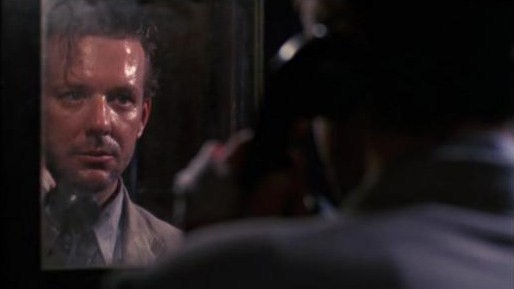
Angel Heart is a terrifying gothic noir thriller writen and directed by Alan Parker. It's about a private detective in 1950's New York called Harry Angel (played by Micky Rourke) who is hired by the demonic Louis Cyphre (Robert De Niro) to find Johny Favourite, a 30s jazz crooner who has been missing since the end of the war. The whole movie feels incredibly bleak and dark, a bit like a nightmare. As if the characters are already in hell. Lisa Bonnet of The Cosby Show plays Johny's morose/sexy daughter Epiphany who'm Harry meets when the hunt takes him to New Orleans.


40. Aguirre, The Wrath of God (1972)
One of Werner Herzog's early films, I think like the best of his work it's truly original. Herzog claims to have never seen a film until he was in his teens, as bizzarre as this sounds I think it's given him a unique perspective and approach to film making. Aguirre is a perfect example of this. Like many of his films its contemplative, water breaks on the rapids of a river for a full minute. It's the Amazon river and the film, almost a documentary, follows a group of sixteenth century conquistadors on an ill fated mission to find a city of gold. Apparently it's also partially a comment on the Vietnam war. The music by krautrockers Popol Vuh is beautiful, Klaus Kinski gives another memorable performance.


39. Bring Me The Head of Alfredo Garcia (1974).
One of my favourite examples of a Sam Peckinpah film. The opening scene featuring a man breaking the arm of his pregnant daughter sets the tone for the rest of the movie. It's a very dark tale about the power of money over a couple of outcast losers. Bad things happen. The amazing Warren Oates plays Bennie, a pianist in a Mexican bar who is approached by two sinister hitmen, Sappensly and Quill, to track down and kill an old aquantance of his, Alfredo Garcia. They offer him one million dollars in exchange for his head. Like in other Pekinpah classics like Straw Dogs, The Wild Bunch and Cross of Iron, the action/violence is beautifully stylised. Incedentally, in the opening scene of From Dusk Till Dawn, George Clooney's character threatens a shopkeeper by stating that he will "turn this place into the fucking Wild Bunch".


38. The House by The Cemetery (1981).

One of my favourite horror films of all time is Lucio Fulci's The House by The Cemetery. I can't begin to express how scary this film actually is. The funny thing is, it shouldn't be: it has an atrocious English language dub (like alot of Italian movies) and it centres around alot of aesthetic horror cliches (a cemetery and an old house with a haunted cellar). The fact that some sequences still make my hair stant on end is a testiment to the directing of Lucio Fulci. The film is incredibly atmospheric. A New York professor researching suicide takes his wife and their young son Bob to stay at an old mansion in a small town. Offcourse, one hundred years ago Dr Fraudstein lived there with his family, which he murdered in order to use their body parts in his experiments. They were buried in the house (apparently a common practice in the 19th century) and now it is haunted by a mysterious creature living in the basement.


37. The 36th Chamber of Shaolin (1978).

Yes! this is a wonderfully uplifting kung fu movie about triumph over adversity and the importance of perseverance and self discipline. Gordon Liu plays San Te, a young student in medieval China who comes to the Shaolin temple in order to learn their form of advanced kung fu so that he can create a resistance force against the invading northern Han empire. It features what is probably the all time greatest training sequences ever that takes up about half the movie. Liu is a legend.


36. Phenomena (1985).

My favourite Dario Argento film, and probably one of his most bizarre. A teenage Jennifer Connelly stars as a young American girl at a boarding school in Switzerland who finds she is capable of telepathy with insects. She teams up with a wheelchair bound Donald Pleasance to solve the murders that have begun to occur in the area. Highlights include a homicidal chimpanzee, general weirdness from Pleasance and a truly astonishing score that seems to mainly consist of Iron Maiden songs.


35. The Last Temptation of Christ (1988)

Not considered one of Scorsese's best films, nevertheless The Last Temptation of Christ is a favourite of mine and one that I seem to end up watching alot. It's an adaptation of the novel by the Greek writer and philosopher Nikos Kazantzakis. While I haven't read the book I think films often benefit from having the structure and concept of a novel behind them. Willem Dafoe's performance as Jesus is quite incredible and Peter Gabriels 80's score still sounds amazing. The minimalistic art direction is also remarkable, the film seems stripped down, spartan. A far cry from the traditional hollywood epic. This seems to suit the subject and recalls another great film based on the life of Jesus: Pasolini's The Gospel According to Saint Matthew.


34. Vertigo (1958)
Vertigo is the most emotionally satisfying of all Hitchcock's movies. I think it was his personal favourite, his magnum opus, and it's my favourite aswell, along with The Birds. James Stewart plays an ex-San Fransico police detective John "Scottie" Ferguson who is forced to retire after an incident on a roof top causes him to suffer from a fear of hights. One day he's approached by an old college friend to act as a private investigator and follow his wife in order to get to the bottom of her strange behaviour. The man believes that she has become obsessed with her dead ancestor Carlotta Valdes, and possibly even possessed by her spirit. It's a truly convincing portrayal of obssession and features one of the greatest unspoken sequences ever, along with one of the greatest musical scores by Bernard Herrmann.